Updated May 03, 2026 · 10 min read
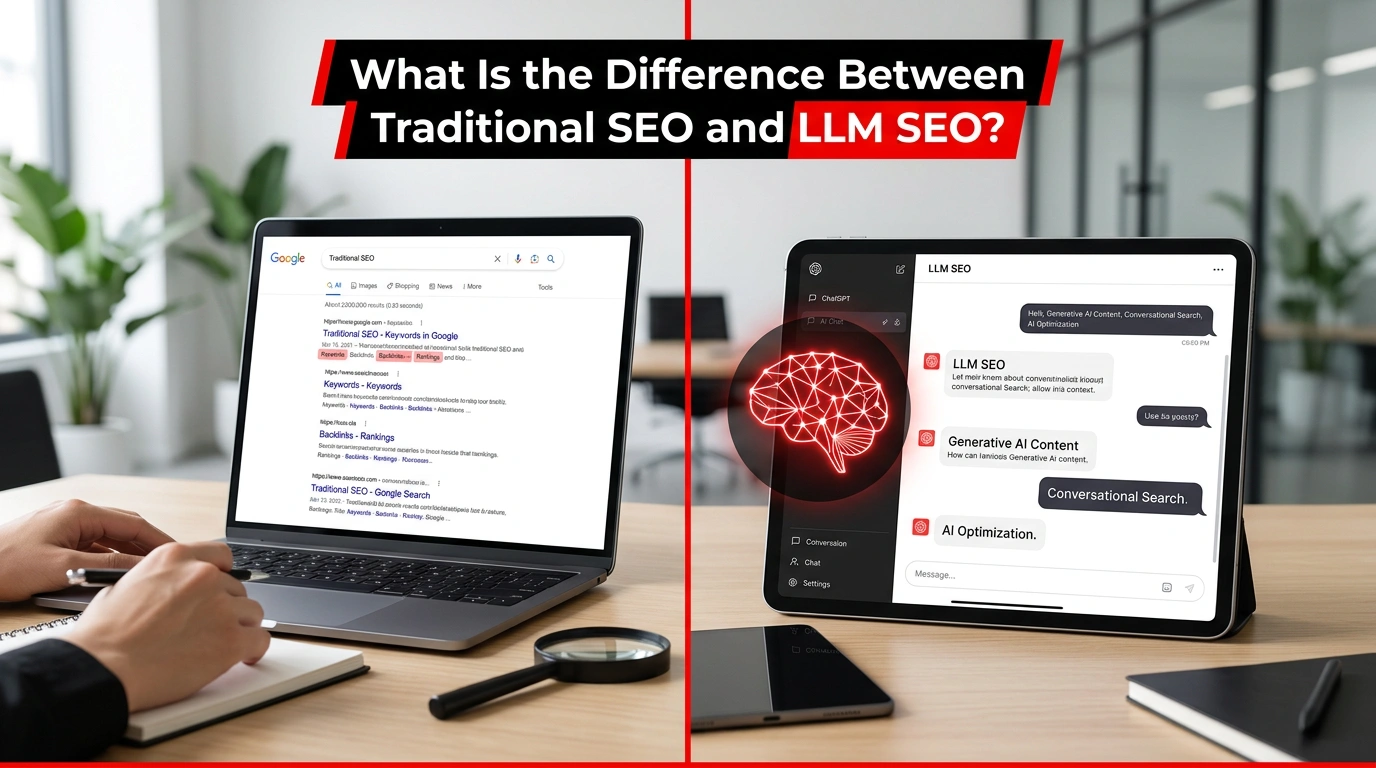
What Is the Difference Between Traditional SEO and LLM SEO?
Traditional SEO optimizes for rankings. LLM SEO optimizes for citations in AI-generated answers. Here's how the two differ and why you need both strategies in 2026.

Table of Contents
- How Search Has Changed
- Traditional SEO: The Retrieval Model
- LLM SEO: The Synthesis Model
- Core Differences at a Glance
- Content Strategy Shifts
- Measurement and Success Metrics
- Do You Need Both?
- Why This Matters for Your Content
- Frequently Asked Questions
Large language models now shape how information gets retrieved, summarized, and recommended across search engines, AI assistants, and enterprise research workflows in 2026. Yet most marketers still optimize the way they did five years ago. The gap between traditional SEO and LLM SEO has become too big to ignore.
Millions skip search engines and go straight to large language models like ChatGPT, Gemini, and Perplexity for answers. This shift changes how your content gets found and whether it gets cited.
How Search Has Changed
For decades, search meant one thing: ranking higher on Google. Search Engine Result Pages (SERPs) have already shifted. Google's AI Overviews and Bing's generative search experiences no longer show users a simple list of ranked blue links. Instead, they see AI-generated summaries pulled from multiple sources.
The difference matters more than you'd think. ChatGPT now refers around 10% of new Vercel signups—up from 4.8% the previous month and 1% six months ago. The momentum is real.
According to Search Engine Land, as of January 2026, 37% of consumers start searches with AI. It's changing how customers discover brands and products.
Traditional SEO: The Retrieval Model
Traditional SEO works around retrieval systems. Search engines crawl pages, index content, evaluate relevance signals, and rank results based on authority, relevance, and technical quality.
The goal has always been simple: get your page to rank on the first page of results so users click through to your site. Keywords, backlinks, and technical optimization were the core tactics. You researched what people searched for, put those keywords in your content, built links to your pages, and fixed technical issues.
Success in traditional SEO is measurable. You check your rankings, monitor traffic, track conversions. The playbook worked for years. But it never answered a different question: how do I get my content selected as a source when an AI system generates an answer?

LLM SEO: The Synthesis Model
Large language models don't retrieve pages to display them. They synthesize information to generate responses. Their goal is to reduce uncertainty for users by providing coherent, confident answers.
The key difference: LLMs predict continuations based on patterns in training data, sometimes combined with fresh information retrieved at runtime. When an LLM answers a question, it's generating text, not ranking existing pages.
While traditional SEO optimizes for ranking, LLM SEO optimizes for representation. Your goal shifts from appearing at the top of search results to being accurately referenced, summarized, and recommended within AI-generated outputs.
Visibility and influence are two separate things. A site can rank well on Google and still never appear in AI summaries. Another site with modest traffic might show up repeatedly in LLM responses. The evaluation criteria are different enough to require separate optimization.

Core Differences at a Glance
| Aspect | Traditional SEO | LLM SEO |
|---|---|---|
| Primary Goal | Rank pages in search results | Get cited in AI-generated answers |
| Success Metric | Keyword rankings, click-through rate | Brand mentions, citations, share of voice |
| Content Focus | Keywords, backlinks, technical signals | Clarity, structure, trustworthiness, consistency |
| Optimization Target | Search engine algorithms | Language model interpretation |
| User Journey | Click link, visit website | Receive answer directly in AI interface |
| Content Evaluation | Keyword density, metadata | Semantic understanding, expertise signals |
| Measurement | Dashboard rankings, organic traffic | AI visibility tools, mention tracking |
Content Strategy Shifts
The tactical differences between the two approaches are substantial. Traditional SEO leans on backlinks and click-through optimization. LLM SEO rewards clear language, structured formats like FAQs and lists, and transparent sourcing.
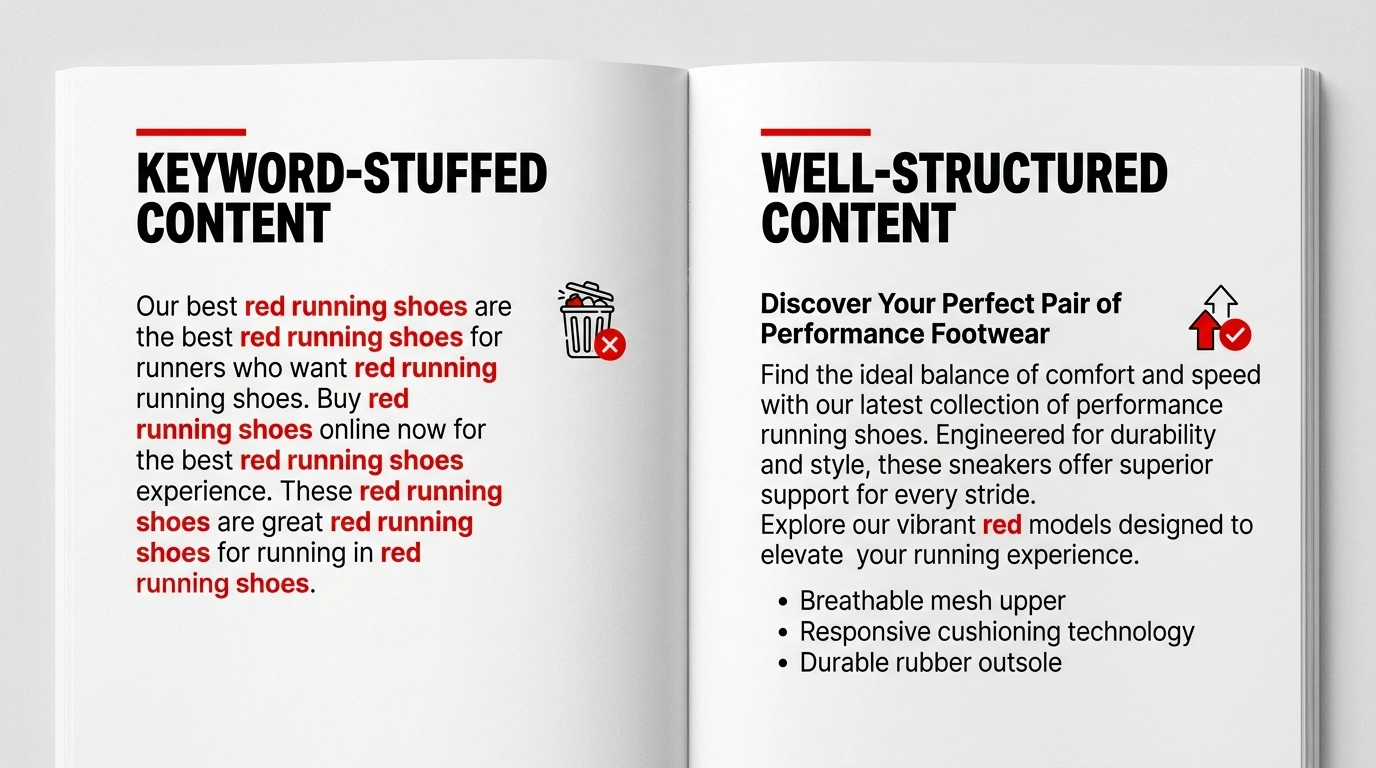
LLMs interpret meaning rather than match keywords. Keyword stuffing or synonym swapping has little impact if the content lacks substance. Models surface the clearest, most semantically rich explanation, not the one that says it the most.
Your content structure carries more weight now. Organize around conversational intent, provide direct answers, and mirror real user questions. Use clear headers and FAQ schema.
A 30–40% visibility lift shows up when content includes citations, quotes, and data. LLMs favor content that can be easily extracted and cited.
Measurement and Success Metrics
Traditional SEO dashboards show rankings and traffic. LLM SEO dashboards show something different.
Mentions: How many times your brand appears in responses. Citations: How often LLMs use your content or sources to answer questions. Sentiment: Whether the mention is positive, neutral, or negative. Position: Where your brand shows up in the response—first, middle, or last.
Measuring LLM SEO success requires different tools than traditional rankings. Specialized platforms like Profound track how often brands and websites appear in AI-generated answers across platforms. Semrush has also rolled out features that measure AI visibility alongside traditional search metrics.
Tracking is messier than traditional SEO. But the payoff matters. When a business gets recommended by an LLM during a search-style query, the conversion rate is "dramatically higher" than traditional channels. For some companies, LLM-referred traffic converts at 30 to 40%, outperforming SEO or paid social.
Do You Need Both?
The answer is yes, but not equally.
LLM optimization and traditional SEO aren't competitors. They're complementary layers. One without the other creates gaps. SEO without LLM optimization limits influence. LLM optimization without SEO limits reach. Modern search performance depends on alignment between the two.
Traditional SEO ensures discoverability, technical reliability, and authority. LLM SEO ensures that discoverable content is correctly interpreted, accurately summarized, and confidently recommended by AI systems. In 2026, sustainable visibility depends on integrating both approaches.
The practical reality: you can't skip traditional SEO. While most ChatGPT citations come from outside Google's top results, websites with more organic traffic get mentioned more in AI search.
Why This Matters for Your Content
You're moving from search ranking to answer shaping. You're not just optimizing for humans. You're also optimizing for models that decide what humans see. That means going deeper, being clearer, and creating content that models can learn from and surface.
Your existing SEO work doesn't disappear. But it needs to be reframed. Speed, technical health, and indexability still matter. What changes is the emphasis. You're no longer fighting for a position on a results page. You're fighting to be the source that AI systems trust enough to quote.
LLMs favor content that explains, not content that persuades. Your goal is to provide information so clear and authoritative that an AI system confidently cites you to answer someone else's question.
At serp.systems, we help brands understand how their visibility has shifted across both traditional and AI-powered search channels. The tools and strategies are evolving rapidly, but the principle stays the same: your content needs to work for both human readers and the AI systems that increasingly decide what those humans see.
Frequently Asked Questions
Is traditional SEO dead?
No. SEO is very much alive. Users still prefer clicking through to sources for in-depth research, and standard search engines provide a breadth of perspectives that AI often lacks. Google remains the primary driver for lead generation and sales. Your SEO work today is what builds the credibility that AI chatbots will use tomorrow.
Can I optimize for LLM SEO without doing traditional SEO?
Not effectively. You can't optimize for AI if your traditional SEO foundations—speed, crawlability, and schema—are broken. If your technical foundation is weak or your topical authority doesn't exist, an LLM won't cite you, and a traditional crawler won't rank you.
How do I measure LLM SEO performance?
Track brand mentions across AI platforms like ChatGPT, Perplexity, and Google AI Overviews. Monitor how often your content is cited, in what position, and with what sentiment. Tools like Profound and Semrush help automate this tracking. Unlike traditional rankings, the metrics focus less on position and more on presence and influence.
What content changes do I need to make for LLM SEO?
Focus on clarity, structure, and comprehensiveness. Use short paragraphs, clear headings, FAQ schema, and bullet points. Answer questions directly rather than burying key information. Include citations, statistics, and expert quotes. Remove keyword stuffing and vague language. Make your content easy for AI systems to extract and understand.
When will AI search completely replace traditional search?
By 2028, LLM chatbots are predicted to reach 15% of the total search market. Traditional search will remain dominant for years, but the split is shifting. Rather than waiting for one to replace the other, the smart move is optimizing for both now.
Does being ranked #1 on Google guarantee AI visibility?
No. SEO ranking doesn't equal LLM visibility. High rankings help, but AI systems evaluate content differently than search engines do. Some well-ranking sites get no AI mentions. Others with modest traffic appear frequently. The evaluation criteria are distinct enough that you need a separate strategy.