Updated April 29, 2026 · 10 min read
What Is the Difference Between On-Page and Off-Page SEO Techniques?
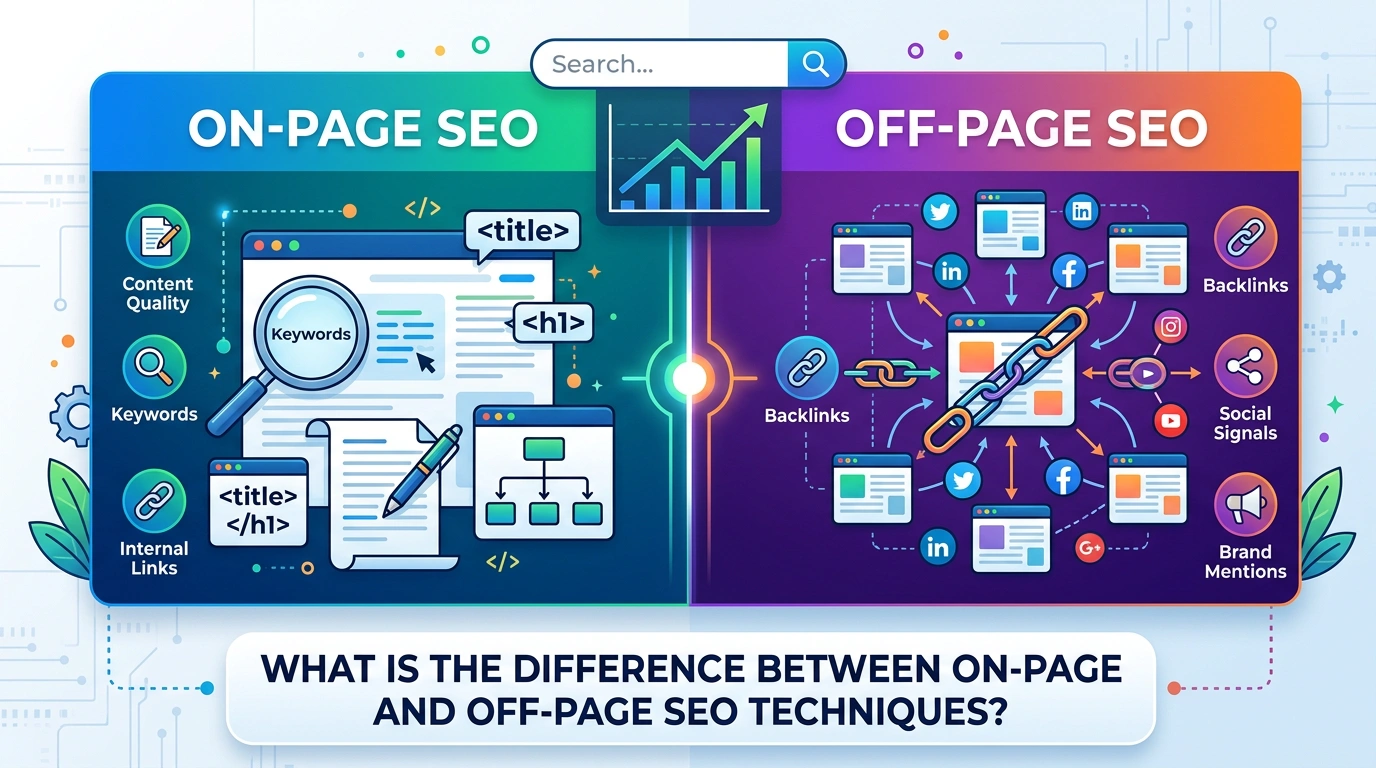
On-page SEO covers everything you control on your website—content, titles, technical setup. Off-page SEO is what happens outside your site—backlinks, brand mentions, social signals. Both are essential to rank competitively in 2026.

On-page SEO is everything you do on your own website to improve it for search engines and visitors, while off-page SEO is everything that happens outside your website that affects your rankings. Both strategies work together to determine where your site appears in search results. Understanding how they differ helps you build a complete SEO approach that actually works.
Table of Contents
- The Core Distinction
- On-Page SEO: What You Control
- Off-Page SEO: Building External Authority
- Key Differences at a Glance
- How They Work Together
- Which Should You Prioritize?
- Measuring Your Progress
- Frequently Asked Questions
The Core Distinction
On-page SEO is everything you do on your own website to make it better for search engines and visitors, and you have complete control over this. Think of it as optimizing the elements directly in your hands—your content, HTML code, page structure, and technical setup.
Off-page SEO is everything that happens outside your website that affects your rankings, like your store's reputation in the community. You don't control these factors directly. Instead, you earn them through relationships, content quality, and how others interact with your brand online.
On-Page SEO: What You Control
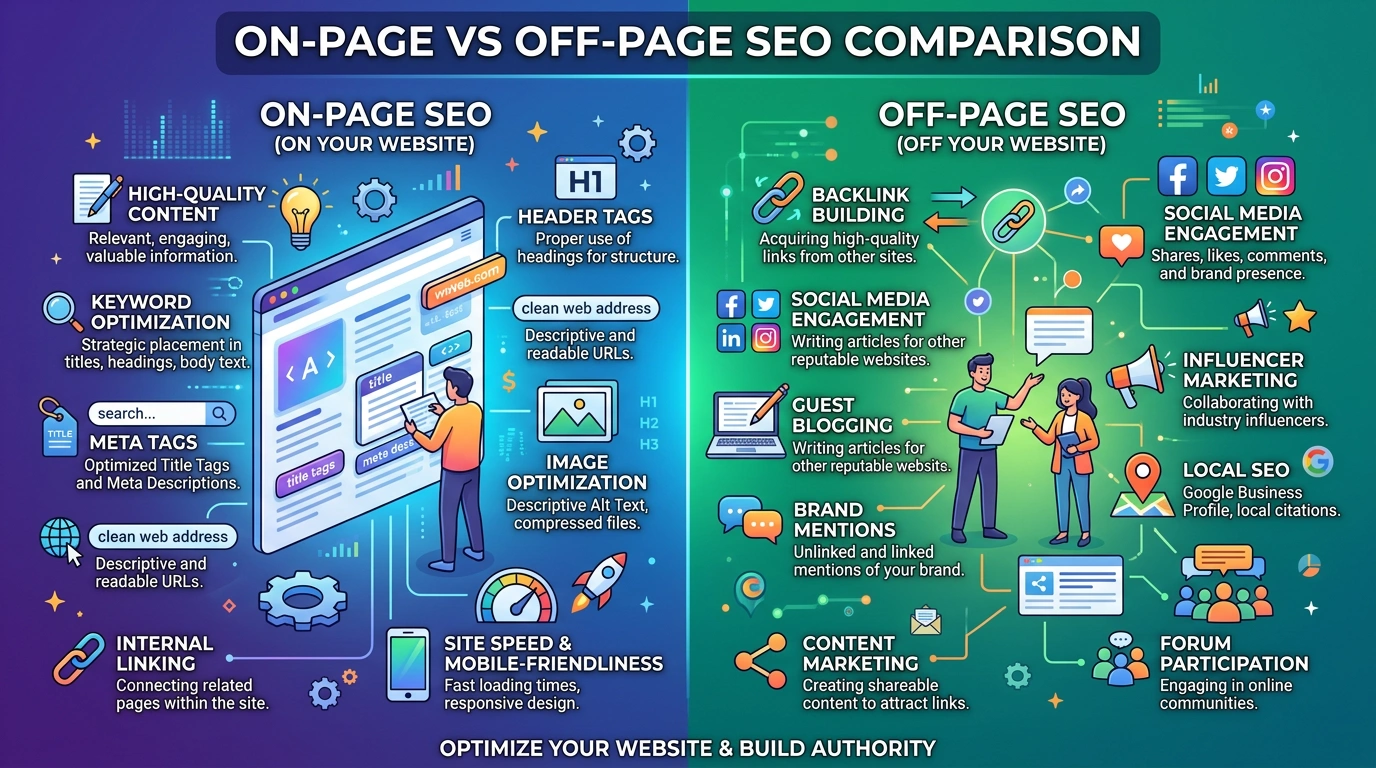
On-page SEO refers to optimizing all the elements inside your website pages to improve search engine rankings and user experience. These are the levers you pull directly on your site. Several core elements matter here.
Content quality and keyword placement form the foundation. Google still uses old-school signals like looking for a specific keyword on your page. But it goes beyond simple keyword matching. Search engines now understand topics and user intent much better than they used to, meaning SEO is not just about repeating one exact keyword anymore—it's about covering topics comprehensively and matching what users are searching.
Meta tags and titles carry real weight. An Ahrefs study found that over 72% of websites have missing optimized meta descriptions. Writing accurate meta descriptions that users find interesting can help persuade users to click your page over others.
Internal linking structure improves how search engines understand your site. Strategic internal links improve site navigation, crawlability, and the distribution of content authority. This means linking related pages together in a way that makes sense for both users and search algorithms.
Technical elements also matter. User experience is a ranking factor, and you can use Google PageSpeed Insights to analyze performance. Page speed, mobile responsiveness, HTTPS security, and clean URL structure all influence how well your pages rank.
Off-Page SEO: Building External Authority
Off-page SEO refers to all the activities performed outside your website to improve its authority, trust, and relevance in search engines. These activities happen beyond your direct control, but you can influence them through strategy and outreach.
Backlinks remain the cornerstone. Backlinks are a key part of Google's algorithm for deciding which sites deserve top spots. But quality matters far more than quantity. The quality, relevance, and source of the backlink significantly impact your SEO. Links from high-authority websites pass more SEO value than links from lesser-known sites, and a backlink from a site in the same industry or niche carries more weight.
Brand mentions and citations build credibility. When people mention your brand name online with or without a link, it's also an off-page SEO signal, and Google also tracks unlinked brand mentions. These mentions signal to search engines that your brand exists and matters.
Social signals and engagement play a supporting role. Active social media profiles and engagement can indirectly impact your search engine rankings by increasing brand awareness, driving traffic to your website, and encouraging natural link building—when your content is shared widely on social media platforms, it increases the likelihood of attracting natural backlinks.
Content distribution and digital PR earn visibility. Publishing original research or infographics that others reference in their content is an excellent way to earn backlinks naturally, and creating newsworthy stories, press releases, and expert quotes can land you mentions in top-tier publications.
Key Differences at a Glance
| Factor | On-Page SEO | Off-Page SEO |
|---|---|---|
| Location | Inside your website | Outside your website |
| Control Level | Complete control | Indirect influence |
| Main Focus | Content, structure, technical | Authority, trust, mentions |
| Primary Elements | Keywords, titles, meta tags, internal links | Backlinks, brand mentions, social signals |
| Speed of Impact | 2-4 weeks for smaller changes | 3-6 months for noticeable results |
| Ongoing Effort | Continuous optimization | Relationship and reputation building |
Unlike off-page SEO, on-page SEO is fully under your control. You can update your content, adjust your technical setup, and optimize your structure whenever you need to. Off-page SEO is not fully under your control because it depends on how other websites and users interact with your content.
How They Work Together
A site with excellent on-page SEO but weak backlinks may struggle to compete, and similarly, a website with strong backlinks but poor content quality will suffer high bounce rates and ranking drops. Neither strategy works in isolation. You need both.
The winner is a third shop that has both great coffee AND great reviews. The analogy works perfectly for SEO. Strong on-page optimization creates the foundation. Your content needs to be relevant, well-structured, and technically sound. But off-page signals prove to search engines that other sites trust you enough to link to you.
To win in competitive SERPs, businesses must integrate both strategies into a single, powerful search engine optimisation plan. This means working on your content and structure while simultaneously building authority through backlinks and brand mentions.
Which Should You Prioritize?
The answer depends on where your website stands. New websites should focus on on-page SEO first to build strong content and structure, established websites should invest more in off-page SEO to grow authority, and e-commerce and competitive niches should maintain a balanced strategy for consistent growth.
For newer sites, on-page SEO is the foundation of your entire SEO strategy—without proper on-page optimization, even strong backlinks and technical SEO cannot deliver results. Get your house in order first. Make sure your content answers user questions, your technical setup is sound, and your pages are properly structured.
For established sites with decent authority, shift focus toward off-page work. On-page SEO is what you directly control—your content, site structure, technical setup—while off-page SEO is what you have to earn from others, and on-page creates the foundation while off-page determines whether you can actually compete.
In competitive niches, you need both working in parallel. Understanding the different types of SEO is essential for building a strong online presence—on-page SEO helps optimize your content, off-page SEO builds authority, and by combining all three types of SEO, businesses can achieve long-term success in search rankings.
Measuring Your Progress
Tracking both types of SEO helps you understand what's working. For on-page improvements, you should see movement relatively quickly. For off-page work, patience matters. You'll probably notice some movement between three and six months—real authority takes longer, Google needs time to find your new backlinks and work out what they're worth, and the meaningful shifts usually happen after six to twelve months.
Use tools to monitor both. Use Google Analytics, Google Search Console, and third-party SEO tools to track metrics, and regularly analyze your data to refine your off-page SEO strategy and ensure you're making progress towards your goals. For on-page work, check your rankings for target keywords and monitor organic traffic. For off-page, track your domain authority, backlink profile, and brand mentions across the web.
Tools like serp.systems help you analyze both on-page and off-page factors in one place, giving you visibility into how your site performs against competitors and where to focus your efforts next.
Frequently Asked Questions
What is on-page SEO with examples?
On-page SEO is the process of improving the structure and content of webpages to increase their likelihood of showing in search results, and examples include strategically placing target keywords in content and writing accurate title tags. Other examples include optimizing meta descriptions, improving page load speed, ensuring mobile responsiveness, and creating clear internal linking structures.
Can you rank without off-page SEO?
It's difficult. On-page SEO is the foundation of any successful SEO strategy—without proper on-page optimization, even strong backlinks may not help you rank. However, without off-page SEO, your website may struggle to compete in competitive niches. For less competitive topics with lower search volume, strong on-page work alone might get you rankings. For any competitive keyword, you need external authority signals.
How long does off-page SEO take to work?
For on-page SEO, you might see improvements in 2-4 weeks for smaller changes. Off-page work takes longer. You'll probably notice some movement between three and six months, and the meaningful shifts usually happen after six to twelve months. This is because search engines need time to discover your new backlinks, evaluate their quality, and adjust your rankings accordingly.
Is on-page or off-page SEO more important?
Both are essential. In 2026, SEO is no longer about tricks—it's about value, experience, and authority, and on-page SEO ensures your website delivers exceptional content and usability while off-page SEO builds trust and reputation across the web. Think of on-page as your foundation and off-page as your proof of credibility. You need both working together.
What are the main on-page SEO factors?
The most important factors that affect internal optimization are page load speed, content quality, keyword use, optimized images, resource structure, internal links, URL structure, and user experience. Additionally, title tags, meta descriptions, heading structure, and schema markup all influence how search engines understand and rank your pages.
How do I build off-page SEO authority?
Safe, sustainable off-page SEO techniques include digital PR to earn coverage, data-led content to publish original stats others can cite, unlinked brand mentions to find mentions and request links, resource page outreach to suggest your best guides, broken link building to replace dead links, partnership links to earn links through real collaborations, and expert contributions through podcasts and webinars. The key is focusing on value and relevance rather than chasing links for their own sake.