Updated May 10, 2026 · 10 min read
On-Page vs Off-Page SEO in 2026
On-page and off-page SEO serve different purposes but both are critical for rankings in 2026. Here's how they differ, why you need both, and what happens when you neglect either one.

SEO strategy splits into two fundamental categories: on-page and off-page optimization. Both matter equally, yet they work in completely different ways. Understanding how they differ helps you build a strategy that actually moves the needle on search rankings.
Table of Contents
- On-Page SEO: What It Is and Why It Matters
- Off-Page SEO: Building Authority Beyond Your Site
- Core Differences Between On-Page and Off-Page SEO
- How On-Page SEO Elements Work
- How Off-Page SEO Elements Work
- Why You Need Both for Real Results
- Why Neglecting Either One Costs You Rankings
- Final Take
- FAQ
- Sources & References
On-Page SEO: What It Is and Why It Matters
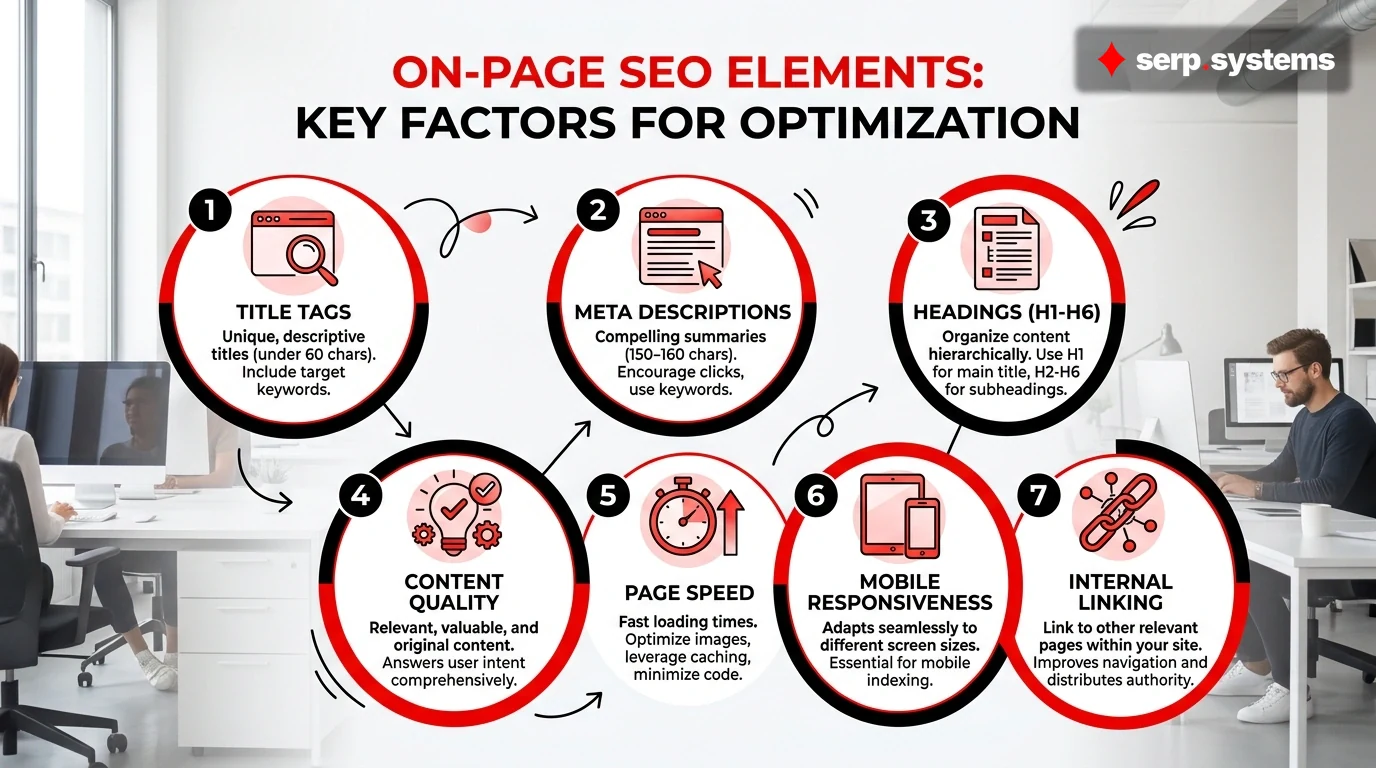
On-page SEO covers everything you control directly on your website. This includes your content, HTML structure, page speed, mobile responsiveness, internal linking, and technical setup. When you optimize on-page elements, you're telling search engines what your page is about and making sure it's easy to crawl and understand.
The foundation starts with your content. Keywords matter, but they're just one piece. Your title tag, meta description, heading hierarchy, and body copy all work together to signal relevance. A page with well-placed keywords but poor structure won't rank as well as one where keywords feel natural and the content flows logically.
Technical factors on your site also count heavily. Page load speed affects rankings directly. Mobile optimization is no longer optional—Google prioritizes mobile-first indexing. Your site architecture, URL structure, and internal linking patterns influence how search engines navigate and understand your content hierarchy.
On-page SEO is immediate and measurable. You can test changes, see results within days or weeks, and refine your approach. This makes it easier to iterate quickly and prove what works for your specific audience.
Off-Page SEO: Building Authority Beyond Your Site
Off-page SEO happens outside your website. It's primarily about building credibility and authority signals that search engines use to rank you. The biggest factor here is backlinks—links from other websites pointing to yours.
Think of backlinks as votes of confidence. A link from a trusted, relevant site carries more weight than one from a random domain. Search engines interpret these links as signals that your content is valuable and trustworthy. A single link from a major publication matters far more than dozens of low-quality links.
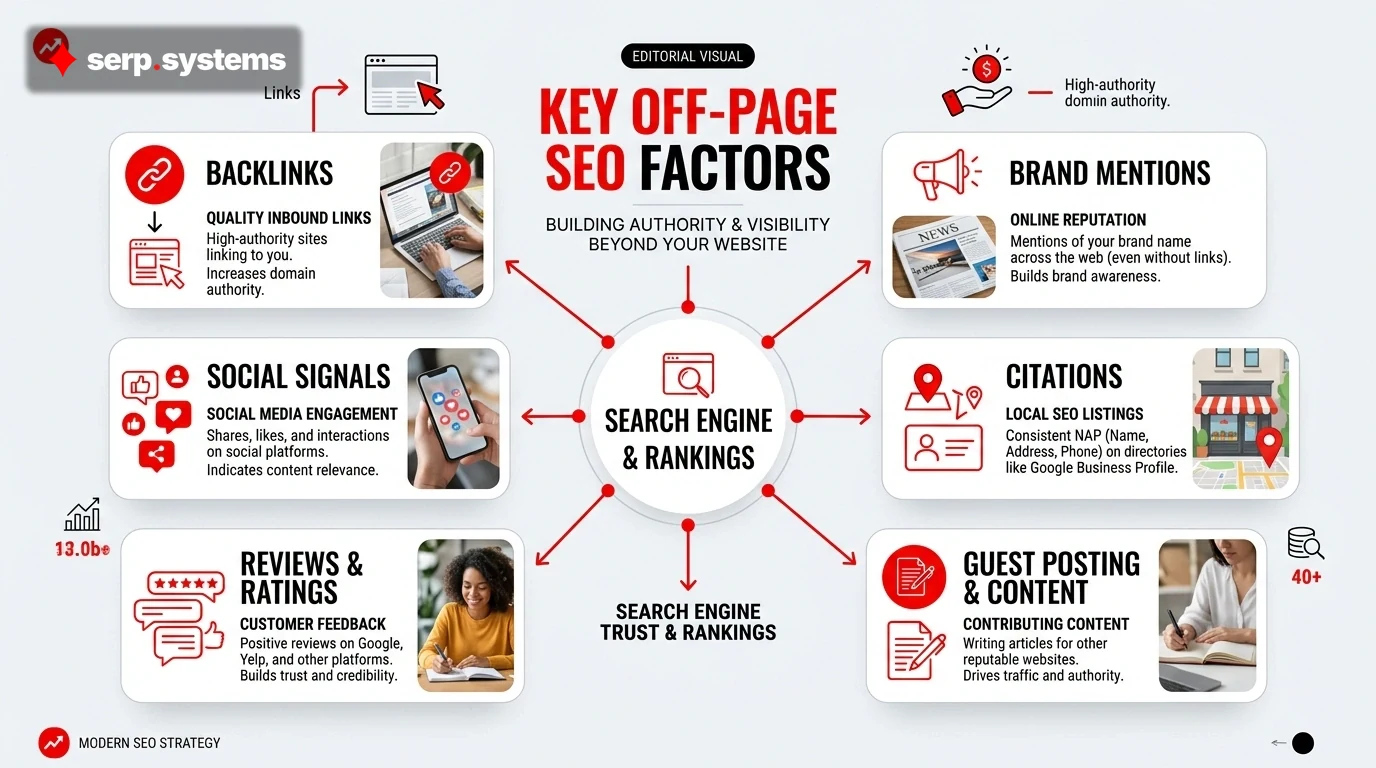
Beyond backlinks, off-page SEO includes brand mentions, social signals, local citations, and your overall online reputation. When people mention your brand across the web—even without linking—that builds authority. Reviews, testimonials, and industry recognition all feed into how search engines perceive your site.
Off-page SEO takes longer to build. You can't force other sites to link to you. You have to earn it through great content, relationships, and visibility. Once you build authority, it compounds over time and becomes harder for competitors to overtake.
Core Differences Between On-Page and Off-Page SEO
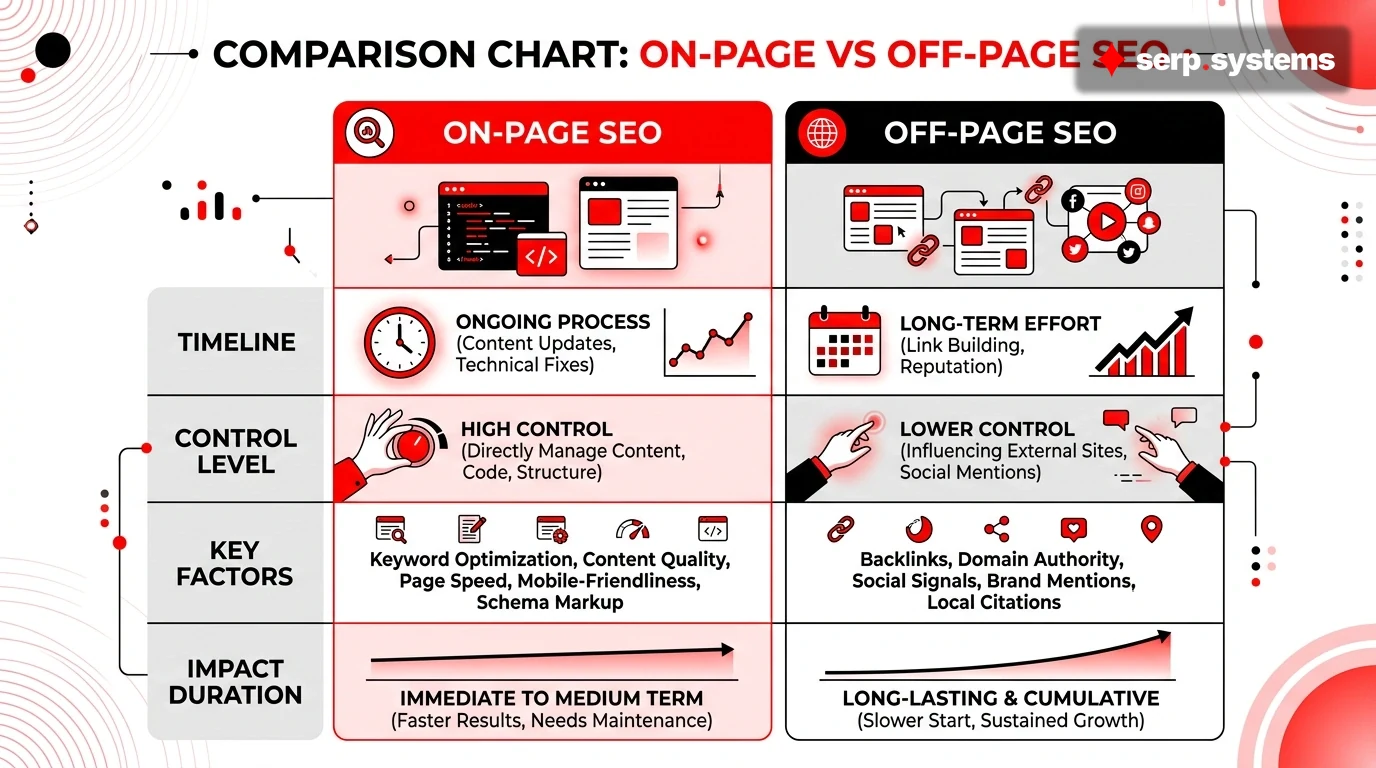
The distinction comes down to control and timeline. On-page SEO is what you do on your own site. Off-page SEO is what happens elsewhere on the internet.
On-page SEO involves: - Content quality and keyword optimization - Title tags, meta descriptions, and heading tags - Page speed and Core Web Vitals - Mobile responsiveness and user experience - Internal linking structure - Schema markup and technical setup
Off-page SEO involves: - Backlinks from external websites - Brand mentions and citations - Social media presence and engagement - Local business listings and reviews - Press coverage and media mentions - Partnerships and collaborations
On-page changes take effect quickly. You update your title tag, and Google can re-crawl your page within hours. Off-page authority builds slowly. A new backlink might take weeks to show measurable impact, and the full value compounds over months.
On-page SEO is entirely under your control. Off-page SEO requires earning trust from other websites and audiences. You influence it through content quality and relationship building, but you can't directly force results.
How On-Page SEO Elements Work
Your content is the starting point. Search engines read your text to understand the topic. If you're writing about "keyword research tools," your page should naturally include that phrase and related terms like "keyword analysis," "search volume," and "competitor research." The content needs to serve the reader first.
Your title tag appears in search results and browser tabs. It's typically 50-60 characters and should include your primary keyword near the front. A strong title tells both users and search engines exactly what they'll find on the page.
Meta descriptions don't directly affect rankings, but they influence click-through rates. A compelling 155-160 character description makes people want to click your result over competitors. Higher CTR sends positive signals to Google about your content quality.
Heading structure (H1, H2, H3) organizes your content logically. Search engines use headings to understand the page hierarchy and main topics. Your H1 should match your primary keyword. Subheadings should cover related topics and questions users might have.
Internal linking connects your pages and distributes authority throughout your site. When you link from a strong page to a weaker one, you pass authority and help search engines understand relationships between topics. Strategic internal linking also keeps users on your site longer.
Page speed matters because users abandon slow sites. Google uses Core Web Vitals—loading speed, interactivity, and visual stability—as ranking factors. A fast site improves user experience and search visibility.
Mobile responsiveness is non-negotiable. Over 60% of searches happen on mobile devices. Your site must look good and function flawlessly on phones and tablets.
How Off-Page SEO Elements Work
Backlinks remain the strongest off-page ranking factor. A link from a high-authority site in your industry signals that your content is credible. Search engines follow these links to discover new pages and assess their importance. The anchor text (the clickable link text) also matters—it should relate to your target keyword or page topic.
Building backlinks requires creating content worth linking to. In-depth guides, original research, and unique perspectives attract links naturally. You can also earn links through outreach, partnerships, and PR efforts. Guest posting on relevant sites builds your profile and generates referral traffic.
Brand mentions amplify your authority even without links. When industry publications mention your company, that builds recognition. Search engines notice these mentions and factor them into your credibility assessment.
Social signals have an indirect effect on rankings. While a Facebook share doesn't directly boost your ranking, it increases visibility and traffic. More traffic and engagement send positive signals. Social profiles also help Google understand your brand better.
Local citations—your business name, address, and phone number listed on directories—matter for local search. Consistency across platforms (Google My Business, Yelp, industry directories) strengthens your local authority.
Reviews and ratings build trust. Sites with numerous positive reviews rank better for local searches. They also influence user decisions before they even visit your site.
Why You Need Both for Real Results
The strongest SEO strategies combine both approaches. On-page optimization makes your site technically sound and content-rich. Off-page authority makes search engines trust you.
Imagine two sites competing for the same keyword. Site A has perfectly optimized content, fast loading speeds, and excellent user experience. Site B has less polished content but strong backlinks from major industry sites. Site B will likely rank higher because authority matters more than perfection.
But flip the scenario. Site B has authority but outdated, thin content. Site A has comprehensive, current content optimized for user intent. Site A will eventually outrank Site B because search engines now prioritize content quality and user experience alongside authority.
The real winning formula uses both. Create content so valuable that other sites want to link to it. Optimize that content for search engines and users. Build your brand so people mention you across the web. This combination compounds over time.
On-page SEO also supports your off-page efforts. Better content attracts more natural backlinks. Faster pages encourage sharing and linking. Good user experience increases time on site, which signals quality to search engines. These signals then help you earn more off-page authority. Analyzing both on-page and off-page factors helps you identify gaps in your strategy and track improvements over time.
Why Neglecting Either One Costs You Rankings
Focusing only on on-page SEO leaves you vulnerable. Your perfectly optimized content won't rank if you have no authority. New sites with great content but zero backlinks struggle for months or years. You need external validation.
Focusing only on off-page SEO is equally risky. You might earn backlinks, but if your content is thin, slow, or poorly structured, users bounce immediately. High bounce rates tell search engines your content doesn't match search intent. Those valuable backlinks won't help.
Search engines want to rank sites that are both technically excellent and authoritative. They want users to find what they're looking for and stay engaged. Neither on-page nor off-page optimization alone achieves that.
The most successful sites invest in both. They publish content that deserves to rank, and they build the visibility and authority to actually reach the top.
Final Take
On-page and off-page SEO aren't competing strategies—they're complementary. On-page optimization ensures your site is technically sound, fast, and content-rich. Off-page authority signals to search engines that your site deserves to rank. In 2026, the sites dominating search results invest in both equally. You can't skip either one and expect real results.
FAQ
What's more important: on-page or off-page SEO?
Both are critical, but they serve different purposes. On-page SEO makes your site crawlable and relevant. Off-page SEO builds authority. In 2026, search algorithms weight authority heavily, so off-page factors often have a bigger impact on rankings. However, poor on-page optimization can tank even an authoritative site. The best approach treats them as equally important parts of one strategy.
How long does it take to see results from on-page SEO changes?
On-page changes can show results within days or weeks. Google crawls updated pages regularly, and changes to title tags, meta descriptions, and content are picked up quickly. However, ranking improvements depend on competition. Less competitive keywords might see movement in a week. Highly competitive terms take longer because you're competing against established authority.
Can I rank without any backlinks?
It's possible but difficult. New sites with no backlinks struggle to rank for competitive keywords. You might rank for very long-tail, low-competition phrases without links. However, for any moderately competitive term, backlinks are nearly essential. They signal to search engines that your content is worth ranking.
What's the easiest off-page SEO tactic to start with?
Building your Google My Business profile is quick and free. Claiming and optimizing your business listing improves local visibility immediately. Creating shareable content is another accessible tactic—if your content is good enough, some people will share it naturally. Guest posting on relevant sites takes more effort but builds authority and referral traffic.
Do social media posts count as off-page SEO?
Indirectly, yes. Social posts don't directly pass ranking authority, but they increase visibility and traffic. More traffic sends positive signals to search engines. Social shares also help content reach more people, which increases the chance of earning natural backlinks. So social media supports your overall SEO strategy without being a direct ranking factor.
How do I know if my backlinks are helping or hurting my site?
Quality matters far more than quantity. A few links from relevant, authoritative sites help you. Many links from low-quality, spammy sites can actually hurt. Use tools that analyze your backlink profile, looking at factors like domain authority, relevance, and anchor text. If you notice suspicious low-quality links, you can disavow them through Google Search Console to prevent them from harming your site.
Sources & References
- Google Search Central Documentation — Official guidance on how Google crawls, indexes, and ranks websites
- Moz's Beginner's Guide to SEO — Comprehensive overview of on-page and off-page optimization principles
- Search Engine Journal — Industry research and studies on SEO trends and algorithm updates