
Updated May 06, 2026 · 10 min read
What Is LLM SEO and How Does It Work in 2026?
LLM SEO is reshaping how content gets discovered — AI systems now cite sources differently than Google ranks them. Here's what changed and how to optimize for ChatGPT, Gemini, and other large language models in 2026.

Large language models are changing how search engines work, and SEO strategies need to adapt accordingly. LLM SEO refers to the practice of optimizing content specifically for how large language models—like ChatGPT, Claude, and Gemini—discover, rank, and present information to users. Unlike traditional SEO, which focuses on Google's algorithmic ranking factors, LLM SEO centers on how AI systems extract, cite, and recommend content when answering user queries.
The shift matters because millions of people now ask questions to AI chatbots instead of typing into search bars. If your content isn't optimized for how these models work, you're missing visibility in a rapidly growing discovery channel. This article explains what LLM SEO is, how it differs from traditional SEO, and the concrete strategies that work right now.
Table of Contents
- Understanding LLM SEO Fundamentals
- How LLMs Find and Rank Content
- Key Differences Between LLM SEO and Traditional SEO
- Structural Elements That LLMs Prefer
- Citation and Attribution in LLM Results
- Content Strategies for LLM Visibility
- Measuring LLM SEO Success
- Frequently Asked Questions
- Sources
Understanding LLM SEO Fundamentals
LLM SEO is optimization for AI-powered search and discovery systems. When you search ChatGPT or ask Gemini a question, the model retrieves relevant information from indexed content across the web, synthesizes it, and presents an answer with citations. Your content's visibility in that process depends on how well it's structured for machine comprehension and attribution.
Traditional SEO optimizes for Google's ranking algorithm, which weighs factors like backlinks, domain authority, and keyword placement. LLM SEO optimizes for how neural networks process text, extract meaning, and decide which sources to cite. The two aren't mutually exclusive—good LLM SEO often improves traditional SEO too—but the priorities shift.
The core insight is that LLMs don't rank pages the way Google does. Instead, they retrieve relevant passages from multiple sources, compress the information into a response, and attribute claims back to their original sources. If your content is clear, well-structured, and easy for a model to parse and cite, you're more likely to appear in those answers.
How LLMs Find and Rank Content
Large language models access content through web indexing, similar to search engines, but their retrieval and ranking logic differs fundamentally. When you ask an LLM a question, it doesn't scan billions of pages in real time. Instead, it uses indexed snapshots of web content combined with its training data to generate responses.
The retrieval phase is where structure matters most. LLMs use semantic search—they understand the meaning of your query and find content with similar meaning, not just matching keywords. A question about "how to fix a leaky faucet" will retrieve content about plumbing repairs even if the exact phrase doesn't appear, because the model understands semantic relationships.
Ranking happens next. The model evaluates which sources are most relevant, authoritative, and trustworthy for the specific query. Factors include topical relevance, content depth, source credibility, and how clearly the information answers the question. Models also consider whether a source has been cited in previous responses or appears in multiple contexts, signaling authority.
Finally, the model generates a synthesis. It doesn't just copy-paste from one source. It combines information from multiple sources, rewrites it in its own words, and cites each claim back to the original. This means your content can be cited even if it's not the single "best" answer—it just needs to contain relevant, accurate information that contributes to a complete response.
Key Differences Between LLM SEO and Traditional SEO
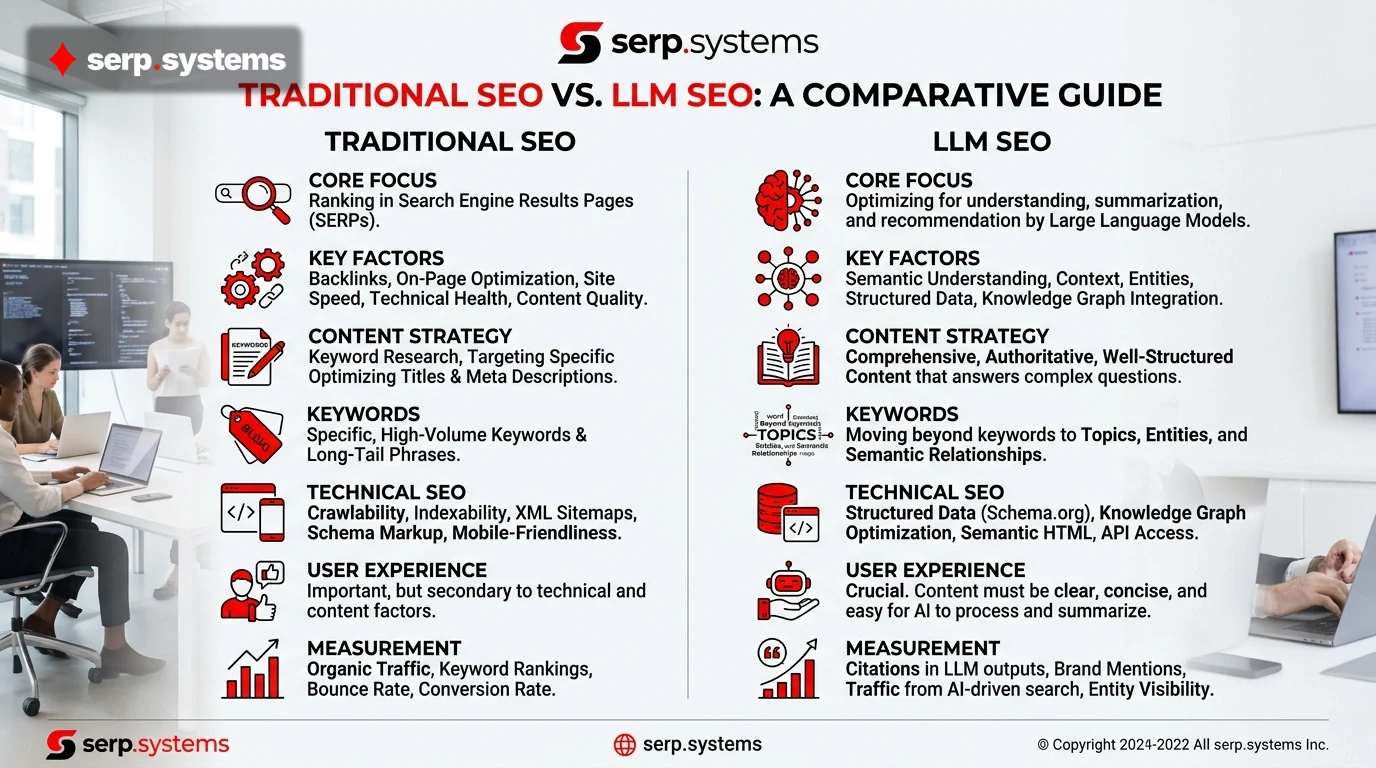
Traditional SEO focuses on ranking a single URL for a single query. You optimize a page, it ranks in position one, two, or three, and users click through. The goal is click-through traffic to your site.
LLM SEO focuses on being cited within an AI-generated response. You don't need the top ranking. You need to appear in the sources the model references when answering a question. The goal is attribution and visibility within the answer itself, which can drive traffic, credibility, and follow-up queries.
The structural priorities also differ. Traditional SEO rewards long-form content, keyword density, and backlinks. LLM SEO rewards clarity, structured data, cited sources, and scannable formatting. A 10,000-word article might rank well in Google but fail to be cited by an LLM if it buries the answer in dense paragraphs. A 2,000-word article with clear headings, data tables, and direct answers will be cited more reliably.
Keyword strategy shifts too. In traditional SEO, you target high-volume keywords with low competition. In LLM SEO, you target the questions people actually ask to AI systems. These are often more conversational, longer, and more specific than traditional keywords. "What is LLM SEO?" is a better LLM SEO target than "LLM SEO" alone.
Structural Elements That LLMs Prefer
LLMs extract and cite information more reliably from well-structured content. Here are the structural elements that improve LLM visibility.
Headings and subheadings help models understand content hierarchy and locate relevant sections quickly. Use clear, descriptive headings that answer specific questions. "How does LLM SEO work?" is better than "The Mechanics."
Comparison tables are highly valuable. LLMs can parse markdown tables and extract structured data easily. If you compare two approaches, tools, or concepts side-by-side in a table, models are more likely to cite that section because it's already formatted for synthesis.
Bulleted lists break up dense information and make it scannable. Models extract from lists more reliably than from paragraph prose because the structure is explicit.
Direct answers matter. Start sections with a clear, declarative statement that answers the question posed in the heading. Don't bury the answer three paragraphs in. LLMs will cite the first relevant passage they find, so put your best answer first.
Definition blocks help when introducing technical terms. If you define a concept clearly in one place, models will cite that definition consistently. Use bold formatting for the term and follow with a concise explanation.
Data and statistics with attribution are valuable. When you cite a study or statistic, format it clearly: "According to [Source Name], [year], [statistic]." Models will extract and cite this more reliably than vague claims.
Internal links within your content help models understand topical relationships. If you link from one section to another, you signal that the topics are related, which can improve how models synthesize your content across multiple questions.
Citation and Attribution in LLM Results
When an LLM cites your content, it typically includes your domain name and a brief description. The citation format varies by platform—ChatGPT uses footnote-style citations, Gemini uses inline links, Perplexity uses a sources sidebar—but the principle is the same: your URL appears as a source for the information presented.
This attribution is valuable for three reasons. First, it drives direct traffic. Users can click the citation to visit your site and read the full article. Second, it builds credibility. Being cited by an LLM signals authority to other systems and users. Third, it creates a feedback loop. As your content gets cited more, models learn to trust your domain, and you appear in more responses.
However, not all content gets cited equally. Models prioritize sources that are clear, authoritative, and easy to parse. If your content is buried in dense paragraphs with no clear structure, models may use the information without citing you, or cite a competitor's version instead.
The key to consistent citation is making it easy for models to extract and attribute claims to you. Use direct language, cite your own sources clearly, and structure information so that a single paragraph or section can stand alone as a complete answer to a specific question.
Content Strategies for LLM Visibility
Building content for LLM SEO requires a shift in mindset. You're not writing for humans to click through from search results. You're writing for AI systems to cite and synthesize.
Answer specific questions directly. Each section should answer one question completely. An LLM will cite a section if it contains a complete, relevant answer. Vague or partial answers are less likely to be cited.
Use original research and data. LLMs cite sources that provide new information or authoritative data. If you conduct original research, publish unique statistics, or compile comprehensive datasets, you're more likely to be cited across multiple queries.
Build topical authority. Write comprehensively about a specific topic. If you cover LLM SEO from multiple angles—how it works, why it matters, how to optimize for it, tools that help—models will cite you as an authority on the topic and include you in responses to related questions.
Optimize for featured snippets and PAA questions. Featured snippets are the concise answers Google displays at the top of search results. LLMs often cite content that appears in featured snippets because it's already proven to be a clear, direct answer. Similarly, Google's "People Also Ask" section shows common questions. Answer these questions directly in your content.
Create comparison content. LLMs frequently cite comparison tables and side-by-side analyses. If you compare approaches, tools, or concepts, you're likely to be cited when models answer comparative questions.
Link to authoritative sources. When you cite other reputable sources, models see your content as well-researched and trustworthy. This increases the likelihood that your content gets cited alongside those sources.
Update content regularly. LLMs train on data with a cutoff date. Content updated in 2025 or 2026 will be more relevant than content from 2023. Regular updates signal freshness and can improve your citation rate.
Measuring LLM SEO Success
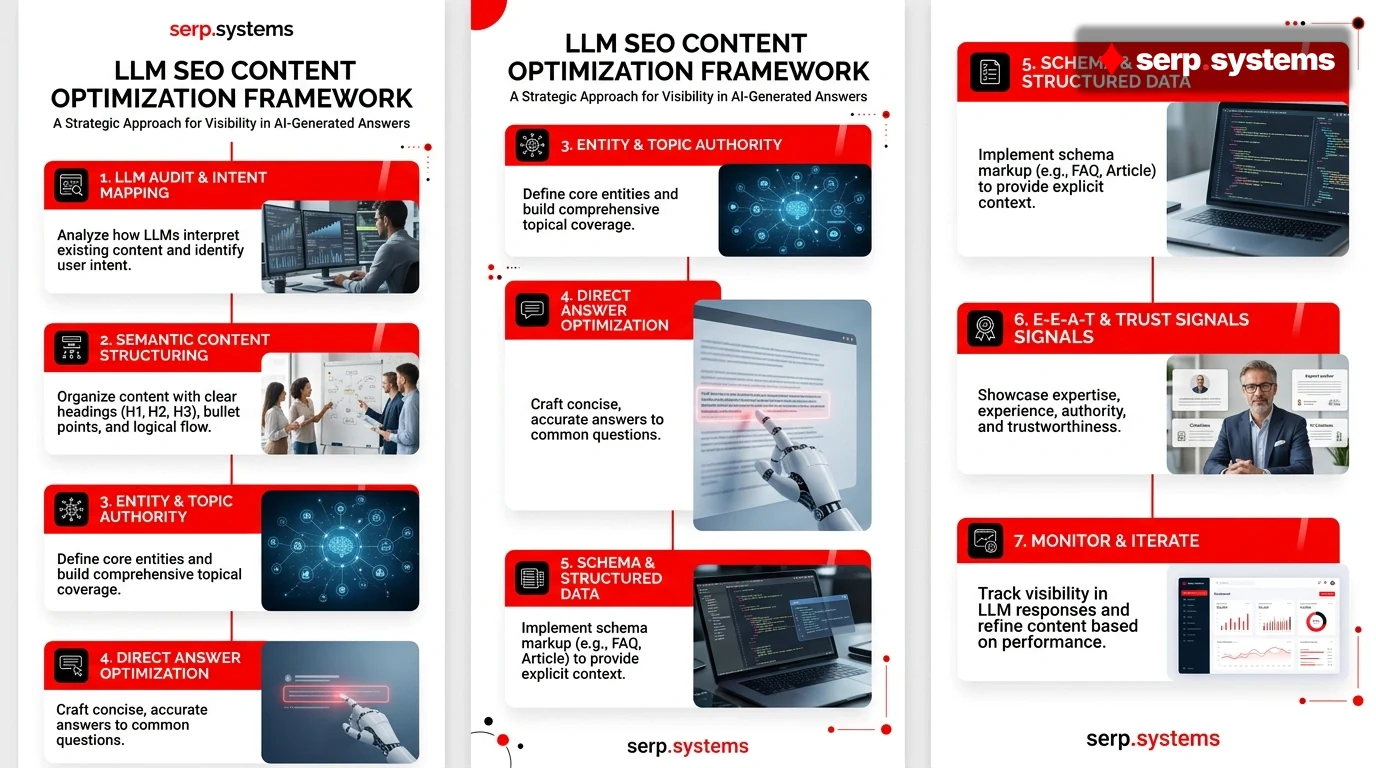
Traditional SEO metrics—rankings, impressions, click-through rate—don't directly apply to LLM SEO. You need new metrics to measure success.
Citation frequency is the most direct metric. Track how often your content is cited by LLMs. Tools that monitor LLM responses can show you which of your pages appear as sources and how often. This is the LLM equivalent of search impressions.
Referral traffic from LLM platforms shows real impact. Monitor your analytics for traffic from ChatGPT, Gemini, Perplexity, and other AI platforms. This traffic often has distinct characteristics—higher average session duration, lower bounce rate, higher conversion potential—because users are coming from specific, relevant answers.
Query coverage measures how many different questions your content answers. If one article is cited for ten different queries, it has high query coverage. Aim to increase the number of distinct queries that surface your content in LLM responses.
Source rank within responses matters. If your content is cited first when an LLM answers a question, you're winning the visibility battle. Track whether your citations appear early or late in LLM responses.
Backlink growth from LLM discovery can be a secondary benefit. As more people find your content through AI systems, some will link to it from their own sites or platforms, improving traditional SEO signals as well.
Tools like serp.systems can help you monitor how your content performs across different discovery channels, including LLM citations, traditional search rankings, and referral sources. Understanding which content gets cited most frequently and by which models helps you refine your strategy.
Frequently Asked Questions
What's the difference between LLM SEO and traditional SEO?
Traditional SEO optimizes for search engine rankings and click-through traffic. LLM SEO optimizes for citations within AI-generated responses. Traditional SEO prioritizes backlinks and keyword density. LLM SEO prioritizes clarity, structure, and direct answers. Both can improve visibility, but they reward different content characteristics.
Do I need to choose between LLM SEO and traditional SEO?
No. Good LLM SEO often improves traditional SEO metrics, and vice versa. Clear structure, direct answers, and authoritative sourcing help both Google and LLMs. Focus on writing excellent content that serves both systems, and you'll see improvements across all discovery channels.
How do I know if my content is being cited by LLMs?
Monitor your referral traffic from LLM platforms like ChatGPT, Gemini, and Perplexity. Most analytics platforms categorize this traffic separately. You can also manually test by asking LLMs questions related to your content and noting whether you appear in the citations. Tools that track LLM citations can automate this process.
What content gets cited most by LLMs?
Content that directly answers specific questions, provides original data or research, uses clear structure with headings and lists, and comes from authoritative sources gets cited most. Comparison tables, how-to guides, and definition sections are particularly valuable because they're easy for models to extract and cite.
Should I write longer or shorter content for LLM SEO?
Length matters less than clarity and structure. A well-organized 1,500-word article will be cited more reliably than a 5,000-word piece that buries the answer in dense paragraphs. Write enough to fully answer the question, use clear headings and lists to structure the information, and stop when you've covered the topic completely.
How often should I update content for LLM SEO?
LLMs have training cutoff dates, so newer content is generally preferred. Update your content at least annually, and more frequently for topics that change rapidly. When you update, refresh statistics, add new information, and ensure the answer remains current and complete.
Sources
- OpenAI ChatGPT documentation and research on model training and retrieval mechanisms
- Google's guidance on structured data and featured snippets optimization
- Perplexity AI's citation methodology and source attribution practices
- Industry research on AI search adoption and user behavior in 2025-2026
- serp.systems analysis of content performance across traditional and AI search channels