Updated May 03, 2026 · 10 min read
What Is Google SEO?
Google SEO in 2026 has shifted beyond keywords and backlinks. High-quality content, E-E-A-T signals, Core Web Vitals, and AI optimization now determine rankings — here's what changed and how to adapt.

Table of Contents
- Understanding Google SEO Fundamentals
- How Google's Search Algorithm Works
- Core Ranking Factors in 2026
- Technical SEO and Site Performance
- Content Quality and User-First Approach
- Building Authority and Trust
- Optimizing for AI-Powered Search
- Frequently Asked Questions
Google SEO—short for search engine optimization—is about helping search engines understand your content, and helping users find your site and make a decision about whether they should visit your site through a search engine. It's the practice of making your website more visible and relevant in Google's search results, which remain the dominant way people discover information online.
Google's organic search market share remains close to 90%, making Google optimization essential for any business seeking organic traffic. But SEO in 2026 has shifted significantly from what it was just a few years ago. It's no longer just about keywords and backlinks. Today, Google rewards websites that genuinely serve users while maintaining technical excellence across all devices.
Understanding Google SEO Fundamentals
Google SEO works by helping Google's automated systems find, understand, and rank your website. Google Search works in three stages: Crawling (Google downloads text, images, and videos from pages it found on the internet with automated programs called crawlers), Indexing (Google analyzes the text, images, and video files on the page, and stores the information in the Google index, which is a large database), and Serving search results (When a user searches on Google, Google returns information that's relevant to the user's query).
The process starts before your pages even rank. The program that does the fetching is called Googlebot (also known as a crawler, robot, bot, or spider), and Googlebot uses an algorithmic process to determine which sites to crawl, how often, and how many pages to fetch from each site.

How Google's Search Algorithm Works
Google uses automated ranking systems that look at many factors and signals about hundreds of billions of web pages and other content in our Search index to present the most relevant, useful results, all in a fraction of a second. This isn't a single algorithm but rather a complex system of interconnected ranking systems.
Google uses over 200 ranking factors in its algorithm, though the exact composition and weighting of these factors remain proprietary. Google's ranking systems are designed to sort through hundreds of billions of webpages and other digital content to present the most relevant, useful results on the first page in a fraction of a second.
The algorithm evaluates five major categories when ranking content. Google's algorithm considers five vital categories when ranking search results: meaning, relevance, quality, usability, and context. Understanding these categories helps you align your content with what Google is actually looking for.
Meaning involves understanding user intent. Google's algorithm employs language models (AI systems trained on human language) to infer a search query's intent, fixes spelling and applies synonyms that correlate with similar content, and gauges the user's the preferred language and media types (like images or video) and considers locality to skew results in favor of nearby businesses.
Relevance focuses on whether your content actually answers what people are searching for. Content that's highly relevant to what people are searching for is more likely to get to the top of Google, and Google tries to understand the underlying reason behind each search—known as search intent—and serve content that aligns with what searchers are looking for.
Core Ranking Factors in 2026
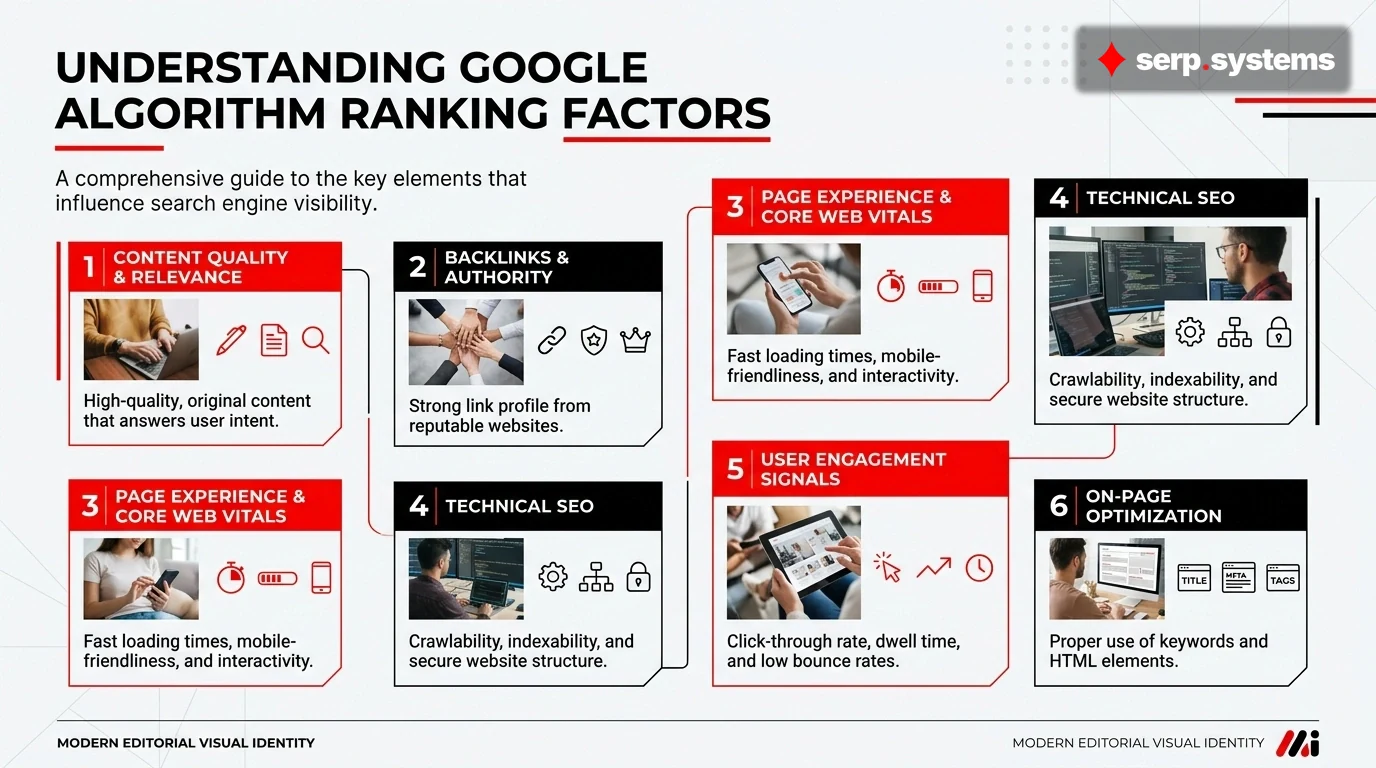
High-quality content, backlinks and search intent are the top three ranking factors in 2026, but what those terms mean in practice has evolved, and Google is rewarding credibility, clarity and focus, with businesses that have been optimizing for the algorithm alone losing ground to businesses that are genuinely helpful and easy to trust.
E-E-A-T signals matter significantly. After identifying relevant content, ranking systems aim to prioritize those that seem most helpful, and to do this, they identify signals that can help determine which content demonstrates expertise, authoritativeness, and trustworthiness.
Backlinks remain important, but their role has evolved. Google has various systems that understand how pages link to each other as a way to determine what pages are about and which might be most helpful in response to a query, and among these is PageRank, one of the core ranking systems used when Google first launched, though how PageRank works has evolved a lot since then, and it continues to be part of the core ranking systems.
Freshness influences rankings for certain query types. Google has various "query deserves freshness" systems designed to show fresher content for queries where it would be expected, and if an earthquake happened recently, then news articles and fresher content might appear.
Technical SEO and Site Performance
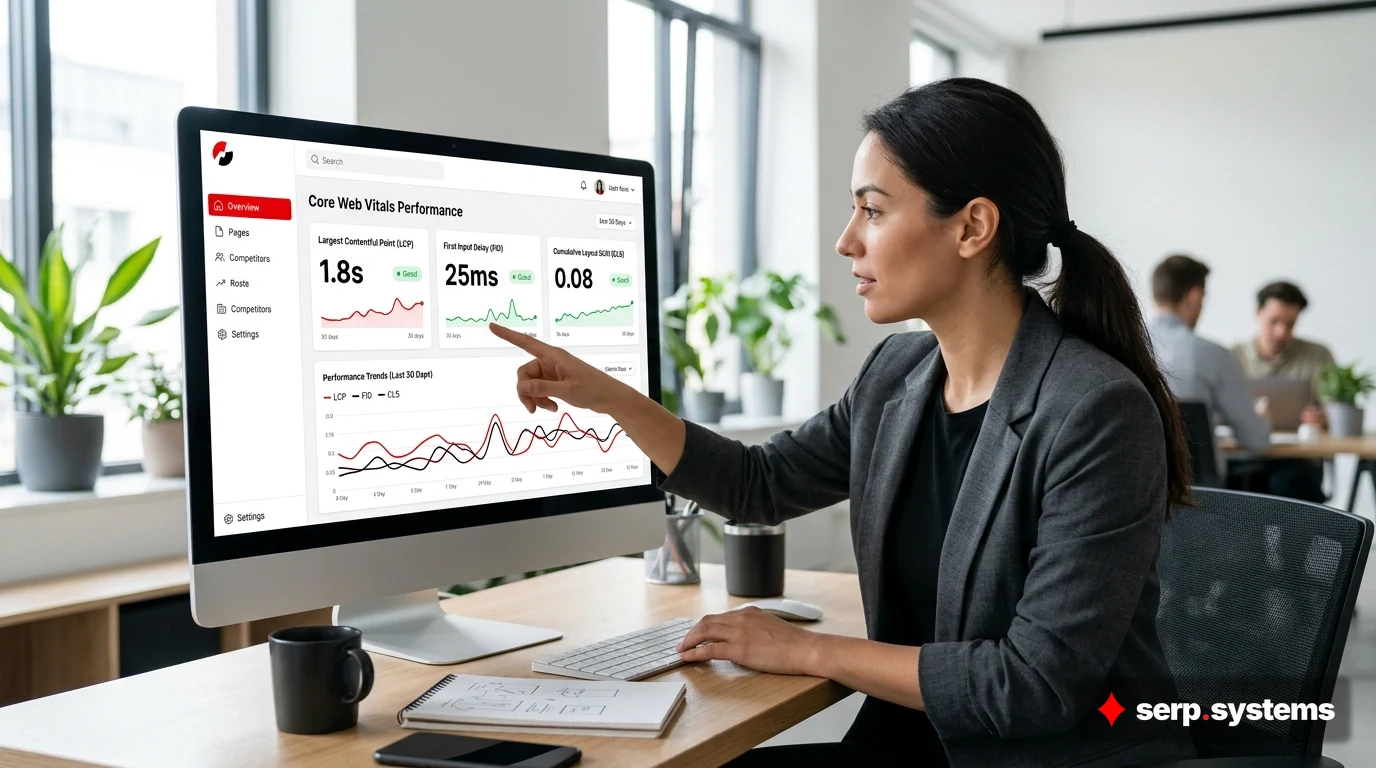
Core Web Vitals remain crucial for SEO in 2026 as Google's primary metrics for measuring real user experience on websites, and these performance signals – Largest Contentful Paint, Interaction to Next Paint, and Cumulative Layout Shift – directly influence how search engines evaluate page quality, though they're not the only ranking factor, they matter significantly in competitive niches where content quality is similar.
The three Core Web Vitals are:
-
Largest Contentful Paint (LCP): Largest Contentful Paint (LCP) measures loading performance and tracks how long it takes for the largest visible content element (usually an image, video, or text block) to appear on screen. The target is under 2.5 seconds.
-
Interaction to Next Paint (INP): Interaction to Next Paint (INP) replaced First Input Delay (FID) as a Core Web Vital, and while FID only measured the first interaction, INP measures the responsiveness of all interactions throughout the page's life. A good score is under 200 milliseconds.
-
Cumulative Layout Shift (CLS): This metric tracks visual stability during page interactions. Traditional CLS measures layout shifts during the initial page load, and VSI goes much further.
The impact is measurable. Studies show that a one-second delay in page load time can reduce conversions by 7%, while poor visual stability frustrates users and drives them away. For e-commerce businesses, this translates directly to revenue loss.
Content Quality and User-First Approach
Google's updates have consistently emphasized the importance of high-quality, user-focused content, and websites should prioritize original content that adds value for the audience. The days of keyword stuffing and thin content are long gone.
A focused page that speaks directly to one type of customer almost always outperforms a page trying to speak to everyone. This specificity signals to Google that your content has a clear purpose and serves a defined audience well.
In 2026, SEO is no longer just about keywords and backlinks, and user experience (UX) has become a confirmed ranking factor, with Google's mission being clear: "To provide the most relevant and reliable information," and if users hate your site, Google assumes it's not reliable enough to deserve a top spot.
User behavior signals matter. Dwell time measures how long users spend on your page before returning to search results, and longer dwell time signals valuable content combined with good design that keeps people engaged.
Building Authority and Trust
Authority isn't built overnight. The E-E-A-T factors (Experience, Expertise, Authoritativeness, Trustworthiness) continue to gain importance and require cross-departmental collaboration, and Google and other search systems increasingly evaluate the overall quality of a brand, not just individual SEO signals.
Google updates primarily affect websites with a lot of organic traffic but a relatively weak brand, and an extensive digital footprint signals to Google that it's a relevant brand. This means your presence across multiple platforms, consistent messaging, and genuine expertise all contribute to your SEO success.
In 2026, search engines are extremely focused on credibility, and with misinformation spreading quickly online, platforms prioritize trustworthy content sources, and Google and other search platforms evaluate signals like expertise, authority, and reliability before ranking content, which means businesses must invest in strong branding, expert content, and authentic engagement.
Optimizing for AI-Powered Search
The search landscape is shifting. Google AI Overviews and AI search engines fundamentally change how users search for and consume information, and AI Overviews reduce organic clicks on the top result by an average of 34.5%.
However, This approach, known as Generative Engine Optimization (GEO), focuses on "Information Gain"—providing unique data points that Large Language Models (LLMs) can use to construct a response. Rather than simply appearing in traditional search results, your content should provide information that AI systems can cite.
The goal in 2026 is to serve as the citation that powers the answer. This requires creating comprehensive, well-researched content that provides original insights rather than rehashing existing information.
SEO has become more holistic. Successful search engine optimization in 2026 requires integration of editorial, IT, UX, PR, and product management, and SEO becomes a holistic strategy that goes beyond Google.
Tools like serp.systems can help you monitor your search visibility across multiple platforms and understand how your content performs in both traditional search and AI-powered answer engines. Comprehensive monitoring gives you the data needed to optimize effectively across all discovery channels.
Frequently Asked Questions
Is Google SEO still important in 2026?
Yes. Despite new platforms emerging, Google still dominates the search industry in 2026, and billions of searches are performed every day, with Google continuing to improve its algorithms using artificial intelligence. Even with AI search engines gaining traction, Google remains the primary traffic source for most websites.
What's the difference between on-page and technical SEO?
On-page SEO involves optimizing content, headlines, and keywords for relevance. Technical SEO focuses on site architecture, performance, crawlability, and user experience signals like Core Web Vitals. Both are essential. Modern SEO success rests on four pillars: Technical excellence, semantic relevance, absolute trustworthiness (E-E-A-T), and AI optimization.
How long does it take to see SEO results?
Results vary depending on competition and current site authority. Google Search Console updates Core Web Vitals data based on 28 days of real user data, and after implementing optimizations, expect to see metric improvements within 4-6 weeks, though ranking improvements may take longer since Google's algorithm considers many factors beyond Core Web Vitals, with most sites seeing measurable ranking changes within 2-3 months of sustained good scores.
Do I need to hire an SEO specialist?
It depends on your resources and expertise. Basic SEO fundamentals—quality content, mobile optimization, and Core Web Vitals—can be managed internally. However, competitive industries benefit from professional SEO strategy. An experienced specialist can identify opportunities and avoid costly mistakes that damage rankings.
How do Google algorithm updates affect my rankings?
Google usually makes several core algorithm updates per year, and some are designated catchy names by the SEO community or Google itself to help notify people about them, prepare for them and make them easier to refer to. Updates typically reward sites with better content quality, user experience, and trustworthiness while penalizing those using outdated tactics.
What's the most important ranking factor?
There's no single most important factor. In SEO, what truly matters stays the same. Quality content, technical excellence, user experience, and trustworthiness work together. In competitive niches, Core Web Vitals can serve as a tiebreaker when content quality is similar.