
Updated May 03, 2026 · 10 min read
What Is SEO for LLMs Called? The Complete 2026 Guide
Generative engine optimization (GEO) is reshaping how brands get discovered in AI responses. ChatGPT, Perplexity, and Google AI Overviews now handle billions of queries daily—and LLM-referred traffic converts 4.4x better than traditional search.

Generative engine optimization (GEO) is one of the names given to the practice of structuring digital content and managing online presence to improve visibility in responses generated by generative artificial intelligence (AI) systems. But the terminology doesn't stop there. The industry uses several overlapping terms to describe this emerging discipline, and understanding the differences—or lack thereof—matters if you're trying to optimize for AI discovery.
Table of Contents
- The Primary Term: Generative Engine Optimization
- Alternative Names for SEO for LLMs
- Why the Industry Hasn't Settled on One Term
- How GEO Differs from Traditional SEO
- Why This Shift Matters in 2026
- Getting Started with GEO Strategy
- Frequently Asked Questions
The Primary Term: Generative Engine Optimization
GEO is the practice of structuring digital content and managing online presence to improve visibility in responses generated by generative artificial intelligence (AI) systems. The practice influences the way large language models (LLMs), such as ChatGPT, Google Gemini, Claude, Perplexity AI and Copilot retrieve, summarize, and present information in response to user queries.
GEO is the practice of optimizing your content to appear as sources and citations in AI-generated responses from platforms like ChatGPT, Perplexity, Google AI Overviews, and Claude. Unlike traditional SEO that focuses on ranking in search results, GEO ensures your content gets cited when AI engines answer user questions.
The core difference from traditional search optimization is fundamental. Generative engine optimization is not about ranking in a fixed position the way Google works. There is no "position #1" in ChatGPT. Instead, visibility in AI search is about frequency. How often does your brand appear across many different responses to many different prompts? Think of it as a mention rate, not a ranking.
Alternative Names for SEO for LLMs
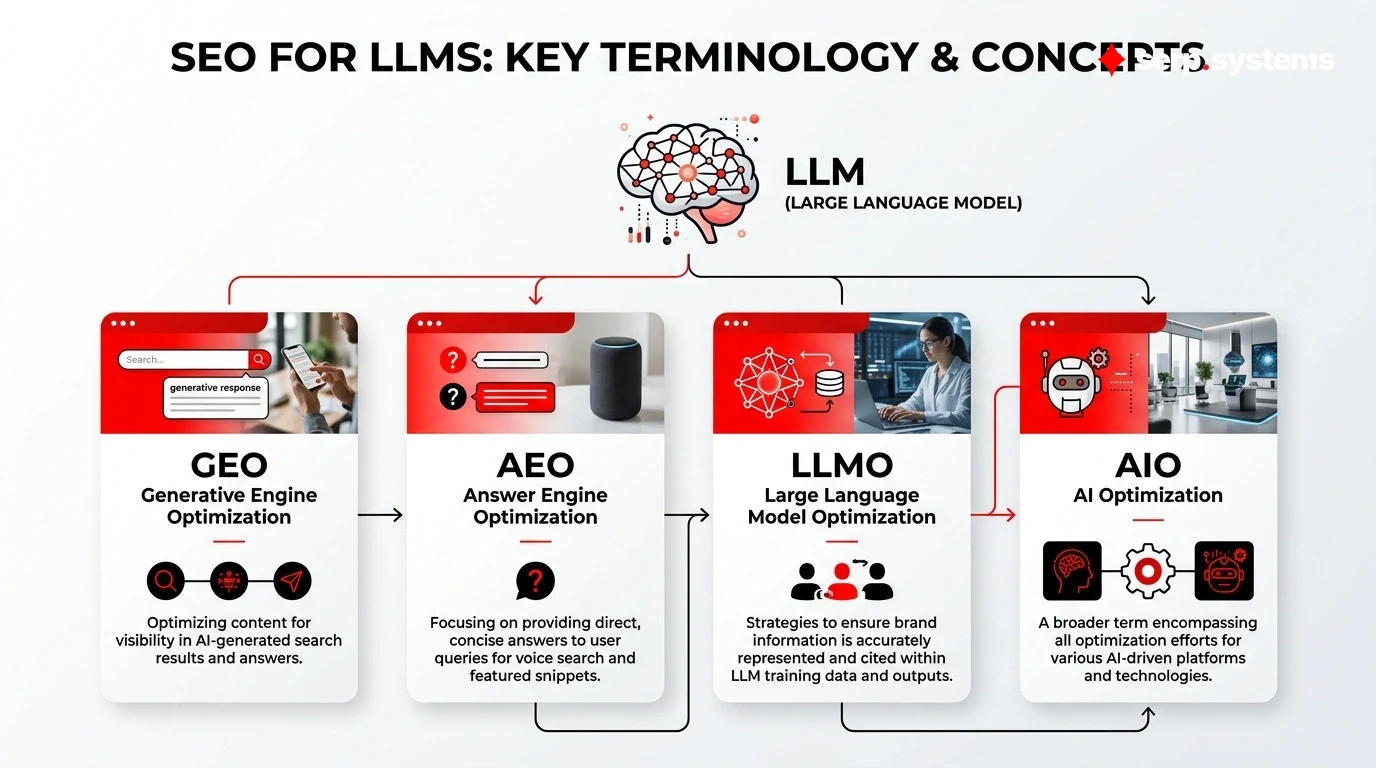
You may also see this called AI SEO, answer engine optimization (AEO), or large language model optimization (LLMO). The industry has not settled on a single term yet. They all describe the same goal. Get your content cited by AI.
Here's what each term emphasizes:
-
Answer Engine Optimization (AEO): Sometimes used specifically in reference to systems designed to return direct answers rather than lists of links, such as voice assistants and featured snippet formats, predating the widespread deployment of large language model-based search.
-
Large Language Model Optimization (LLMO): Used in some practitioner contexts with a narrower focus on influencing a model's parametric knowledge rather than on retrieval-based systems.
-
Artificial Intelligence Optimization (AIO): Used in academic and practitioner contexts as a broader umbrella term covering any practice aimed at structuring content and messaging so that it can be effectively interpreted by AI systems acting as an audience or intermediary.
-
AI SEO: Used when the practice is positioned as a direct continuation of traditional search engine optimization workflows adapted for AI-mediated discovery environments.
Why the Industry Hasn't Settled on One Term
No consensus definition distinguishing these terms had been established in the academic literature as of early 2026, and the terms are frequently used interchangeably in trade and practitioner contexts. This lack of standardization reflects how new the discipline is. The field emerged only in response to LLMs becoming mainstream search tools, so practitioners, vendors, and researchers are still building shared language around it.
The terminology confusion doesn't matter much in practice. The industry uses several terms for the same broad goal. Generative engine optimization (GEO) and answer engine optimization (AEO) are two other common terms. They all describe different angles on the same challenge.
How GEO Differs from Traditional SEO
Understanding what makes GEO distinct from SEO is critical for strategy. Generative engine optimization and traditional SEO share the same foundation. Both reward high-quality, authoritative content. Both require solid technical implementation. But they differ in some important ways. If you have been doing solid SEO work, you are already most of the way there with GEO. The fundamentals have not changed.
However, the emphasis shifts. Unlike traditional SEO, which focused heavily on keywords and backlinks, AI search optimisation prioritises structure, semantic clarity and contextual completeness. Where SEO optimizes for ranking position, GEO optimizes for citation frequency. Share of voice is the most important metric for LLM SEO. It measures how frequently your brand appears in AI responses across a broad range of prompts. Because LLMs are non-deterministic (they produce different answers each time), visibility is about frequency, not position. There is no "position #1" in ChatGPT. Instead, think of it as a mention rate. The higher your share of voice, the more often users see your brand in AI-generated answers.
Why This Shift Matters in 2026
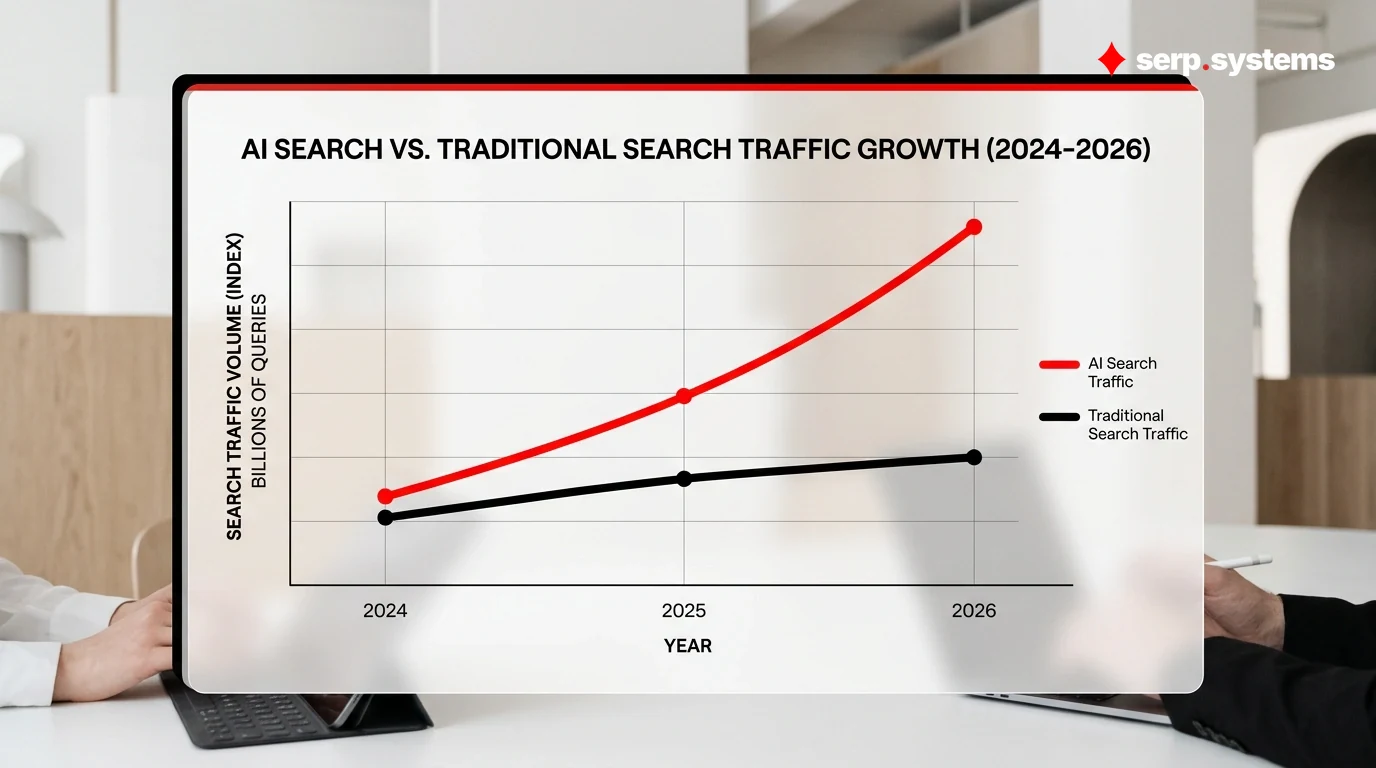
The rise of generative search is reshaping digital visibility. These platforms now handle billions of queries per day. ChatGPT alone processes over 2.5 billion prompts daily and serves more than 400 million weekly active users.
Semrush reports that the average visitor from LLMs converts 4.4x better than traditional search traffic. This conversion advantage makes GEO investment urgent, not optional. When a business gets recommended by an LLM during a search-style query, the conversion rate is "dramatically higher" than traditional channels. LLM-referred traffic is converting at 30 to 40%, which "blows away what we see from SEO or paid social."
By 2026, visibility will depend less on page position and more on whether a brand is cited within AI-generated responses. This represents a structural shift in how discovery works. Users often don't click anything. Nearly 60% of U.S. and EU searches end without an external click, according to SparkToro's 2024 zero-click study. For marketers, that means less traffic from rankings alone.
Getting Started with GEO Strategy

Implementing GEO doesn't require abandoning SEO. Rather, it extends SEO principles for AI systems. Generative engine optimization (GEO) is the practice of optimizing content so that LLMs like ChatGPT and Gemini cite it as a trusted source in their responses. It's looking for content that's easy to parse and reference, and that has authority indicators showing it can be trusted. GEO works by structuring content intentionally to make it AI-friendly in these ways, with a focus on authority, clarity, and factual accuracy.
Content structure becomes critical. Clear semantic structure is foundational. Headings must signal intent explicitly. Definitions should be concise and self-contained. Each section should begin with a direct answer to the implied question in the heading.
Platform presence matters too. Social media marketing and user-generated content now have a greater impact than ever on AI search visibility. Platforms like YouTube, Reddit, and LinkedIn are the most frequently cited across AI engines, with each LLM showing its own preferences. Google tends to surface content from platforms like Facebook and Yelp, while ChatGPT frequently cites Reddit and Wikipedia, and Perplexity emphasizes sources like Reddit, LinkedIn, and G2.
Tools like serp.systems can help track how your brand performs across different AI engines and monitor citation frequency. Understanding where your content appears in AI responses—and why—is essential for refining your strategy over time.
Key Structural Elements for GEO Success
Content that performs well in GEO environments typically includes:
- Direct answers to specific questions without requiring surrounding context
- Clear heading hierarchies using H2 and H3 tags
- Structured data and schema markup for FAQs and definitions
- Comparison tables and lists that AI can extract easily
- Fact-based statements with supporting evidence
Content that is easy for AI systems to retrieve, understand, and reuse is most likely to appear in generative AI responses. In practice, this means clear, direct answers to specific questions, self-contained explanations, fact-based comparisons, and concise definitions that make sense without surrounding context. AI systems tend to pull individual passages, not entire pages, so structure and clarity matter more than length.
Measuring GEO Performance
Measuring large language model SEO success requires different metrics and tools than traditional search optimization. Most AI search is zero-click, so standard analytics will miss the full picture. Share of voice is the most important metric for LLM SEO. It measures how frequently your brand appears in AI responses across a broad range of prompts.
Rather than tracking rankings and clicks, focus on:
- Citation frequency across ChatGPT, Perplexity, and Google AI Overviews
- Brand mentions in AI-generated answers
- Share of voice relative to competitors
- Referral traffic from AI platforms
- Conversion rates from AI-referred visitors
Frequently Asked Questions
What's the difference between GEO and SEO?
Traditional SEO focuses on optimizing for search engines, while GEO focuses on optimizing for AI engines, which generate results by pulling information from multiple sources. SEO targets ranking position; GEO targets citation frequency in AI responses.
Is GEO replacing SEO?
No. Traditional SEO remains essential. GEO and AEO enhance rather than replace SEO, as generative engines rely on many of the same authority and relevance signals that traditional search algorithms use. Both work together in a modern search strategy.
Which AI platforms should I optimize for?
Different AI engines surface content in unique ways. It's important to understand your key audiences and where they search, and format your content intentionally to optimize for all LLMs and search engines where you want to appear. The major platforms include ChatGPT, Perplexity, Google AI Overviews, Claude, and Gemini.
Can small publishers compete in GEO?
Yes. Well-known brands often start with more authority, but they don't automatically win. Smaller publishers can compete when they own a clearly defined topic, show up consistently across platforms, and are easy for AI systems to understand and trust.
How quickly will GEO traffic grow?
According to Semrush, AI search visitors may surpass traditional search visitors in 2028. If Google also changes its default search console to AI Mode, this fact can turn into reality sooner. The shift is accelerating faster than many expected.
What content performs best for GEO?
Research reports, data-driven articles, comprehensive FAQs, how-to guides, and structured comparisons perform well across both GEO and AEO optimization strategies. Content that helps buyers make decisions is more critical than ever.