Updated June 11, 2026 · 10 min read
Answer Engine Optimization vs AI SEO: Why Your Strategy Matters in 2026
AI SEO and Answer Engine Optimization target completely different systems. One optimizes for Google rankings; the other builds citations in ChatGPT, Gemini, and Perplexity. Here's why the distinction matters for your 2026 strategy.

The language around AI and search has become a source of real confusion for brands trying to stay competitive. Most companies know that artificial intelligence has changed how people search, but the terminology they're reaching for—"AI SEO"—often describes something entirely different from what they actually need.
The distinction between AI SEO and Answer Engine Optimization (AEO) matters because they target completely different systems. One focuses on ranking in Google's list. The other focuses on being cited in ChatGPT, Gemini, Claude, and Perplexity responses. For brands trying to reach high-value clients in 2026, this difference has become essential.
Table of Contents
- What AI SEO Actually Does
- Understanding Answer Engine Optimization
- Core Differences Between Approaches
- Authority Signals That Matter to AI Answer Platforms
- Why Brands Confuse These Two Strategies
- Building an AEO Strategy for Your Brand
- When to Use AI SEO Tools (And When Not To)
- The Competitive Advantage of AEO in 2026
- Frequently Asked Questions
What AI SEO Actually Does
AI SEO refers to the use of artificial intelligence tools to accelerate and scale traditional search engine optimization work. These tools automate keyword research, generate content at speed, create meta descriptions, analyze competitor rankings, and optimize on-page signals for Google's algorithm.
The output of AI SEO is faster, cheaper optimization for a system that has remained largely unchanged since the early 2000s: a ranked list of results. You apply AI-powered tools to the same SEO playbook that worked in 2015, just with better efficiency.
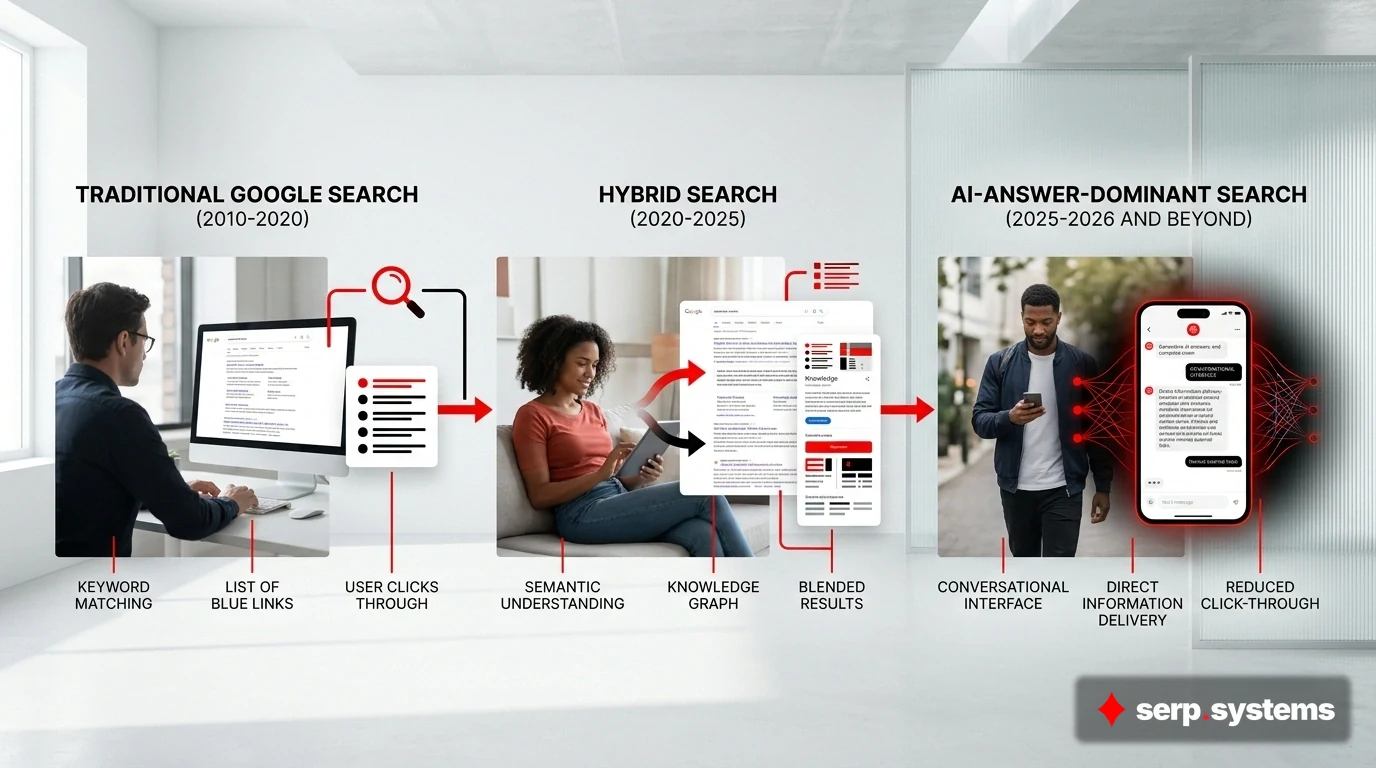
Tools that handle keyword clustering, content generation, and SERP analysis have their place in a modern marketing stack. However, they're solving for visibility in a search model that's already becoming secondary for many high-value queries. When a prospect asks an AI assistant a complex question, they're not getting a ranked list. They're getting a synthesized answer with citations.
Understanding Answer Engine Optimization
Answer Engine Optimization is the practice of building the specific authority signals that AI answer platforms use to select and cite a brand as the definitive expert in a field.
When ChatGPT, Gemini, or Perplexity generates an answer to a user's question, it doesn't simply pull the top ten Google results and summarize them. These platforms use their own citation logic, their own authority models, and their own understanding of which sources deserve to be recommended to users asking expert questions.
AEO strategy is built around making your brand visible and credible to those systems. You're not competing for ranking position. You're competing to be the single name an AI assistant recommends when someone asks "Who should I hire for this?" or "What's the best approach to this problem?"
Core Differences Between Approaches
The two disciplines address completely different systems and produce completely different outcomes.
| Aspect | AI SEO | AEO |
|---|---|---|
| Target System | Google's ranked list algorithm | AI answer platform citation logic |
| Success Metric | Position in search results (rank 1-10) | Being cited as the recommended source |
| Key Signals | Keywords, backlinks, on-page optimization | Entity clarity, topical authority, direct attribution |
| Content Focus | Keyword-optimized pages | Expert-authored, attributed content |
| Timeline | Weeks to months for ranking changes | Months to establish authority signals |
| Visibility | Appears in Google results | Appears in ChatGPT, Gemini, Perplexity answers |
A brand that invests in AI SEO without addressing AEO may rank well in traditional search results while remaining completely invisible in the AI-generated answers their most valuable prospects are already reading and trusting.
This gap is particularly acute in competitive professional markets—law, finance, medicine, executive search. The clients worth pursuing in these fields are already using AI assistants to vet experts. If your brand isn't cited in those answers, your ranking position becomes almost irrelevant.
Authority Signals That Matter to AI Answer Platforms
Understanding what makes a brand visible in AI answers requires understanding the specific signals these platforms prioritize. They differ significantly from the signals Google's algorithm values.
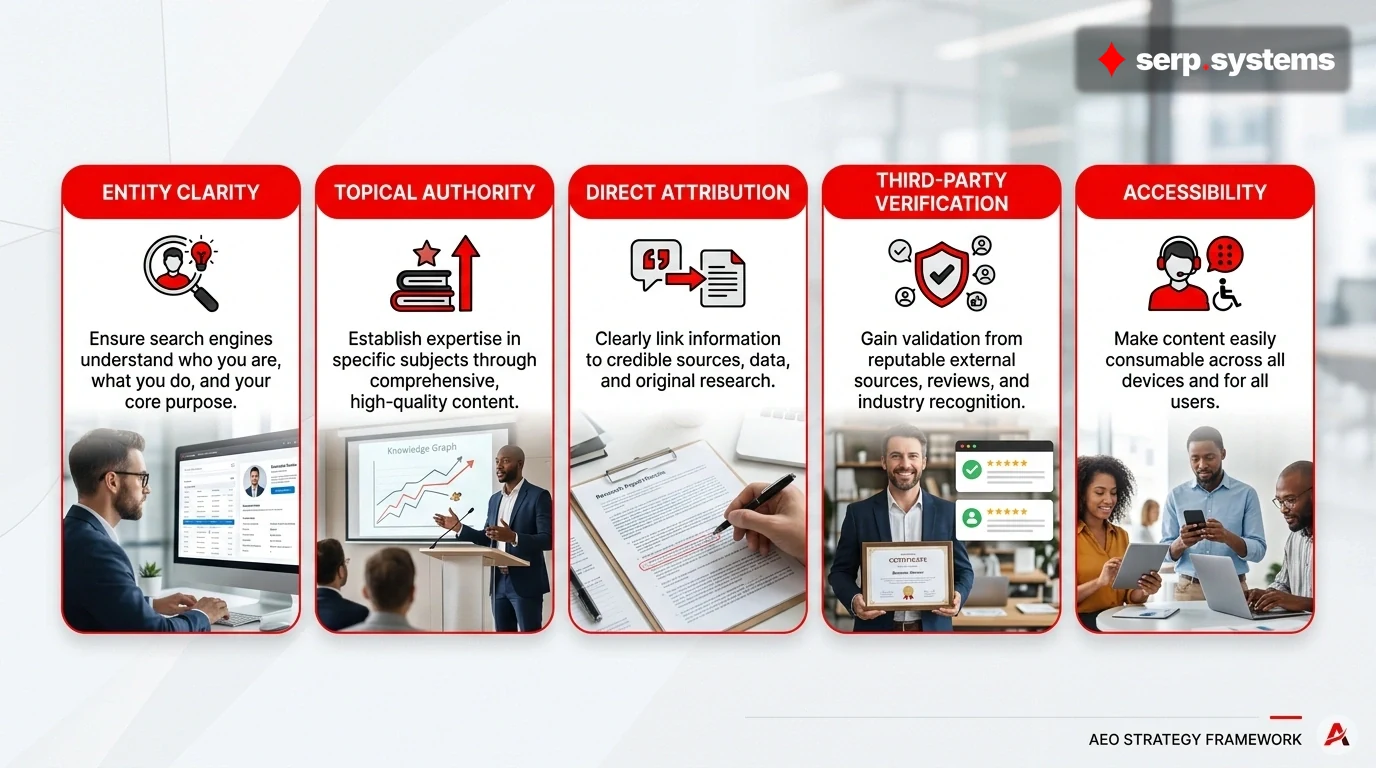
Entity Clarity stands first. AI answer platforms need to understand exactly who you are, what you do, and what domain you own expertise in. This means consistent, clear attribution of your expertise across multiple contexts. When you publish content, your identity as the author and expert must be unambiguous to the platform.
Topical Authority comes next. AI platforms evaluate whether your body of work demonstrates deep, sustained expertise in a specific domain. A single well-written article on a topic doesn't signal authority. Consistent, interconnected content that builds on itself and demonstrates progression in understanding does.
Direct Attribution and Bylines matter more than they did in traditional SEO. When your name appears as the author of expert content, and that attribution is consistent across platforms, it builds the authority signals AI systems use to decide whether to cite you.
Third-Party Verification amplifies these signals. When other authoritative sources cite your work, quote your expertise, or reference your research, AI platforms treat that as validation of your authority.
Accessibility of Your Expertise also factors in. If your best thinking is locked behind paywalls, in private communities, or in formats AI platforms can't easily parse, you're invisible to the systems that recommend experts. Your most valuable insights need to be publicly available and easily discoverable.
These signals operate on a different timeline than traditional SEO. Building topical authority takes months of consistent, expert-authored content. It can't be rushed with AI content generation tools. It requires real expertise being published under a real name.
Why Brands Confuse These Two Strategies
The confusion between AI SEO and AEO is understandable. The terminology around AI and search is evolving faster than the market can absorb it.
Brands know that AI has changed search. They know they need to do something about it. When they search for help, they reach for the most available vocabulary: "AI SEO agency" or "AI SEO services." This phrase combines two concepts they're already familiar with—artificial intelligence and search engine optimization—into language that feels like it describes what they need.
What most brands actually mean when they search for "AI SEO" is something more specific: they want to appear inside the AI answers their clients are already reading. That's an AEO problem, not an AI SEO problem. But the language they use to describe their need doesn't match the solution they're actually looking for.
This gap creates a real risk. A brand that finds an AI SEO agency and implements an AI SEO strategy, expecting to gain citations in ChatGPT and Perplexity, will almost always be disappointed. The tools and tactics that optimize for Google's ranked results don't build the authority signals that AI answer platforms use to make citation decisions.
The stakes are highest for brands in competitive professional markets. In law, finance, medicine, and executive services, the highest-value clients are already using AI assistants to research and vet experts. Time spent optimizing for a system these clients aren't using is time not spent building visibility in the system they are using.
Building an AEO Strategy for Your Brand
If your goal is to be cited in AI-generated answers—and for most high-value B2B brands in 2026, it should be—your strategy needs to be built around AEO principles from the start.
Start with Entity Clarity. Define exactly what your expertise is and who you are as an expert. This should be consistent across your website, your author bios, your social profiles, and any platform where your work appears. Your name, your title, your domain of expertise, and your credentials should be immediately clear.
Build Topical Authority. Create a sustained body of expert-authored content that demonstrates deep knowledge in your specific domain. Focus on publishing fewer pieces with higher expertise and consistency. Each piece should build on previous work and contribute to an overall narrative of authority in your field.
Publish Under Your Name. When you write, your byline matters. AI platforms use author attribution as a signal of expertise. Content published under your name, with your credentials clear, builds your authority profile in ways anonymous or ghostwritten content cannot.
Make Your Expertise Accessible. Your best thinking should be publicly available, not locked behind paywalls or exclusive communities. If you want to be cited by AI platforms, your expertise needs to be discoverable and readable by those systems.
Earn Third-Party Citations. When other authoritative sources reference your work, quote your expertise, or cite your research, it amplifies your authority signals. This happens naturally when you're publishing genuinely valuable expertise, but you can also actively pursue speaking opportunities, publication features, and expert quotations that increase your visibility to other authoritative sources.
Platforms like serp.systems can help you monitor your visibility across both traditional search and AI answer platforms, track how your content is being cited, and identify gaps in your authority signals. But the core work—publishing expert content under your name, building topical authority, and earning third-party citations—is work that can't be automated.
When to Use AI SEO Tools (And When Not To)
This doesn't mean AI SEO tools have no value. They do. They're useful for certain specific tasks within a broader strategy.
If you're publishing expert content, AI tools can help you optimize that content for discoverability in traditional search. They can help identify related keywords and topics you should cover. They can assist with meta descriptions and technical optimization. What they shouldn't do is replace the expert authorship and topical depth that AEO requires.
Think of it this way: AI SEO tools optimize the delivery mechanism. AEO strategy builds the authority that deserves to be delivered. You need both, but in the right order and proportion. Too many brands are spending 80% of their effort on delivery optimization and 20% on building actual authority. The ratio should be reversed.
The Competitive Advantage of AEO in 2026
By mid-2026, the brands that will dominate their markets are those that recognized this shift early and built their strategies around it.
The brands still optimizing primarily for Google's ranked results will find themselves increasingly competing for clients who are no longer using that system to find experts. The brands that built AEO strategies will be the ones cited in the AI answers those clients are actually using.
In competitive professional markets, this difference compounds quickly. The first brand in a field to establish clear AEO authority gains a citation advantage that's difficult for competitors to overcome. Once an AI platform has learned to cite you as the expert in your domain, that citation tends to persist and strengthen.
The brands that wait, hoping that traditional SEO will eventually adapt to AI search, will find themselves years behind the curve. The shift from ranked results to AI-generated answers is already happening, and it's accelerating.
Frequently Asked Questions
What's the main difference between AI SEO and AEO?
AI SEO uses artificial intelligence tools to optimize for Google's traditional ranked results—automating keyword research, content generation, and on-page signals. AEO optimizes for AI answer platforms like ChatGPT and Perplexity by building authority signals those platforms use to select and cite experts. AI SEO targets a list; AEO targets being the recommended answer.
If I invest in AI SEO, will I get cited in ChatGPT and Perplexity?
Not necessarily. AI SEO tools optimize for signals that Google's algorithm values—keywords, backlinks, on-page optimization—but these aren't the primary signals AI answer platforms use to make citation decisions. You could rank well in Google while remaining invisible in AI-generated answers. The two systems use different authority models.
How long does it take to build AEO authority?
Building meaningful AEO authority typically takes 3-6 months of consistent, expert-authored content publication. You're not waiting for algorithm updates or building backlinks. You're establishing a clear pattern of expertise that AI platforms can recognize and cite. The timeline is shorter than traditional SEO in many cases, but it requires consistency and real expertise.
Can I use AI tools to write content for an AEO strategy?
AI tools can help with editing, structure, and optimization of expert content, but they can't replace the expert authorship itself. AI-generated content without real expertise behind it doesn't build the authority signals AEO requires. Your content needs to be authored by a genuine expert in the field, with your name and credentials clearly attached.
Should I completely abandon AI SEO if I want to focus on AEO?
No. You should build an AEO strategy as your primary focus, but continue basic optimization for traditional search. Many of your prospects will still use Google, and there's no reason not to be visible there. The shift to AI-answer-dominant search is real, but it's not complete. You need visibility in both systems.
How do I know if AEO is right for my business?
AEO is most critical if your business serves high-value clients, requires trust and credibility to win deals, operates in a competitive professional market, or targets decision-makers who use AI assistants to research and vet experts. If your clients are already using ChatGPT or Perplexity to find experts in your field, AEO should be a core part of your strategy.