Updated May 16, 2026 · 10 min read
Can AI Replace Human SEO Specialists in 2026?
AI is reshaping SEO work in 2026, but it's not replacing human specialists—it's changing their role. Here's what AI handles, where humans still matter, and which skills specialists need to survive.

The question of whether artificial intelligence can replace human SEO specialists has moved from theoretical debate to practical reality. As machine learning tools become more sophisticated, many organizations wonder if they still need human expertise or if algorithms can handle search optimization alone. The answer depends on understanding what each brings to the table.
Table of Contents
- What AI Can Do for SEO
- Where Human Expertise Still Matters
- The Hybrid Approach Works Best
- Real-World Examples of AI and Human Collaboration
- Skills SEO Specialists Need to Survive
- The Future of SEO Work
- Frequently Asked Questions
What AI Can Do for SEO
Artificial intelligence excels at processing vast amounts of data and identifying patterns that humans might miss. Modern AI systems can analyze competitor websites, track keyword performance across thousands of terms, and generate content recommendations in seconds. These tools handle repetitive tasks with remarkable speed and consistency.
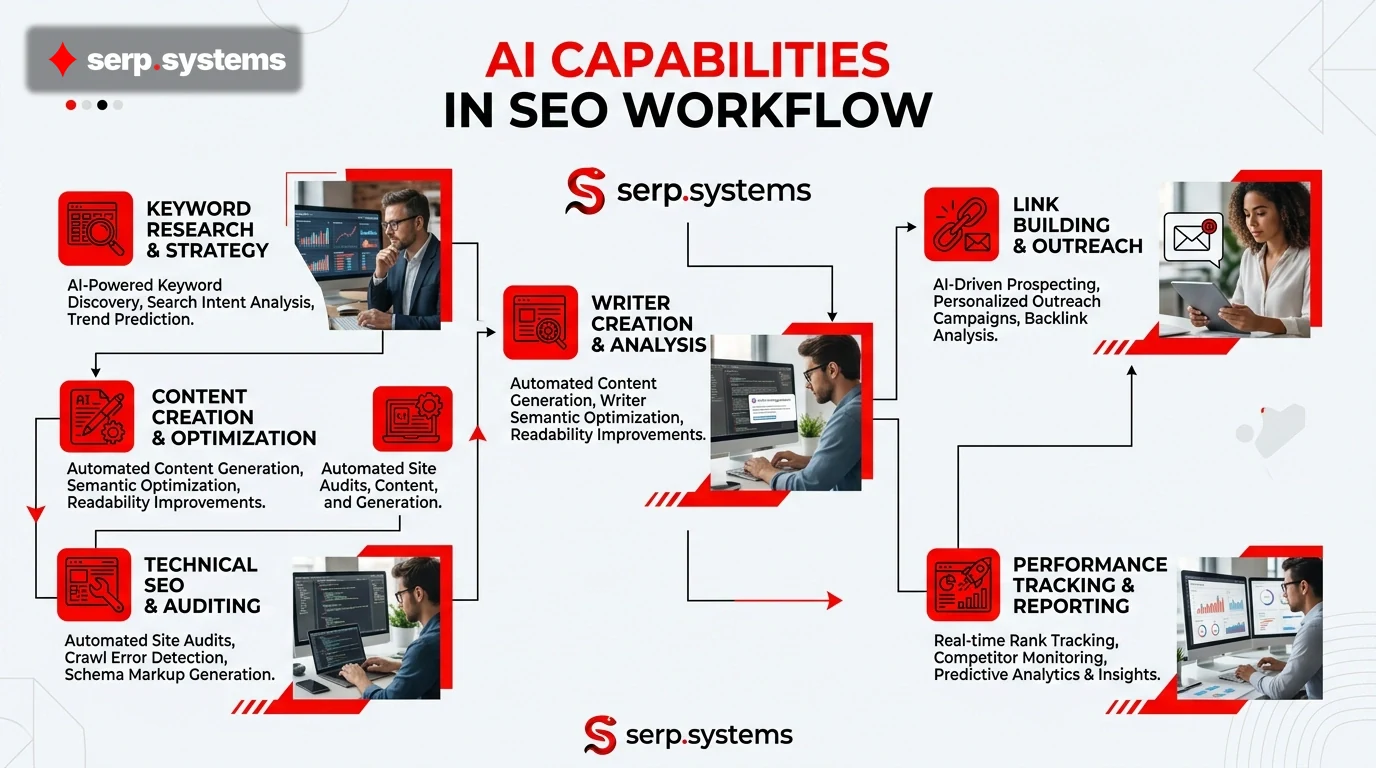
Machine learning algorithms can predict which content topics will perform well based on search trends and user behavior. They monitor ranking changes in real time, flag technical issues on websites, and suggest optimizations for page speed and mobile responsiveness. AI can also generate initial drafts of meta descriptions, title tags, and heading suggestions based on target keywords and competitor analysis.
Natural language processing has improved significantly, allowing AI to understand semantic relationships between words and concepts. This means AI can identify long-tail keyword opportunities and topic clusters that deserve coverage. The technology can also audit existing content for keyword relevance and recommend structural improvements.
However, AI's strength lies in speed and scale, not judgment. These systems work best when they handle data collection, analysis, and initial recommendations. The strategic decisions—which opportunities matter most, how to position a brand, what tone resonates with an audience—still require human thinking.
Where Human Expertise Still Matters
Human SEO specialists bring strategic judgment that algorithms cannot replicate. They understand business goals beyond rankings. A specialist knows that ranking for a high-volume keyword might not matter if it doesn't convert visitors into customers. They can evaluate whether pursuing a particular keyword aligns with company resources and competitive positioning.
Search engine optimization involves understanding user intent at a deeper level than keyword matching. A human specialist recognizes that someone searching "best running shoes" might want reviews, while another person searching the same phrase wants to buy. AI can flag these variations, but humans make the specific decisions about which intent groups to target first.
Content creation requires creativity and domain expertise. While AI can generate text quickly, it often lacks the depth, original perspective, and authority that builds trust with readers. A financial advisor writing about investment strategy brings real experience. An AI writing the same topic might produce grammatically correct but generic content that doesn't stand out.
Relationship building and communication remain distinctly human skills. SEO specialists coordinate with content teams, developers, executives, and external partners. They translate technical recommendations into language that non-technical stakeholders understand. They negotiate priorities when SEO recommendations conflict with other business needs. No algorithm handles these conversations.
Strategic planning requires understanding industry-specific dynamics. A specialist working in healthcare knows regulatory constraints. One working in e-commerce understands seasonal trends and inventory cycles. They apply this contextual knowledge to make decisions that pure data analysis cannot support.
The Hybrid Approach Works Best
The most effective organizations in 2026 combine AI tools with human expertise. Humans excel at strategic thinking and creative problem-solving. AI excels at processing data and identifying patterns. Each has distinct advantages, and combining them produces better results than either alone.
AI handles the heavy lifting of data analysis, monitoring, and initial recommendations. It processes competitor data, tracks rankings, identifies technical problems, and flags content gaps. A human specialist then reviews these findings with strategic thinking. They ask: "Does this opportunity fit our business?" "Can we execute this well?" "What will our competitors do in response?"
This division of labor makes specialists more effective, not less. Instead of spending hours analyzing spreadsheets, they focus on strategy. Instead of manually checking hundreds of pages for technical issues, they review AI findings and make judgment calls about which problems to fix first.
Tools like those available through serp.systems automate routine analysis while leaving decision-making to professionals. A specialist can run a content audit, see which pages underperform, and decide whether to update, consolidate, or remove them. The AI does the heavy analysis; the human makes the call.
AI tools themselves require human oversight. They can produce biased recommendations, miss important context, or misinterpret data. Someone needs to validate findings and catch errors. That someone is a human SEO specialist.
Real-World Examples of AI and Human Collaboration
Companies that have invested in AI-powered SEO tools report interesting outcomes. They don't eliminate their SEO teams—they expand what those teams can accomplish. A team of three people using AI tools can now handle work that previously required five people, while maintaining or improving quality.
One pattern that emerges is specialization. Rather than every specialist doing everything, teams divide into roles. One person focuses on technical SEO and site architecture, using AI to monitor and diagnose issues. Another handles content strategy, using AI to research topics and identify gaps. A third manages link building and authority, using AI to find opportunities and track competitor activity.
This specialization actually increases demand for expertise. Specialists need to understand not just SEO, but also how AI works, what its limitations are, and how to interpret its recommendations. The skill set has shifted, but the need for skilled people has not disappeared.
Organizations without human specialists but with AI tools often struggle. They get recommendations but lack the judgment to prioritize them. They see that a competitor ranks well for a keyword but don't understand why pursuing that keyword might waste resources. They implement changes without understanding the reasoning, which leads to inconsistent results.
Skills SEO Specialists Need to Survive
The specialists thriving in 2026 have adapted their skill set. Technical knowledge remains important, but it's no longer sufficient. Successful specialists now understand AI—what it can and cannot do, how to evaluate tool recommendations, and how to combine automated insights with strategic thinking.
Data literacy has become essential. Specialists need to read and interpret analytics reports, understand statistical significance, and spot anomalies in data. They're not doing calculations by hand anymore, but they need to understand what the numbers mean.
Communication skills have become more valuable, not less. As technical work becomes automated, the ability to explain findings to non-technical stakeholders matters more. Specialists need to translate algorithm recommendations into business language and help executives understand why certain SEO investments matter.
Strategic thinking is now the core differentiator. The specialists most in demand are those who can look at a business, understand its competitive position, and develop a multi-year SEO strategy. They use AI tools to execute that strategy, but they're not dependent on tools to think strategically.
Additionally, specialists who understand specific industries or verticals have strong job security. A specialist with deep healthcare knowledge combined with SEO expertise is far more valuable than someone with only SEO skills. The same applies to finance, e-commerce, SaaS, and other sectors.
The Future of SEO Work
Looking ahead, SEO specialists will not disappear, but their role will continue to evolve. The job is becoming more strategic and less tactical. Specialists will spend less time on repetitive analysis and more time on planning, decision-making, and communication.
The demand for SEO expertise may actually increase. As search engines become more sophisticated and competition intensifies, organizations need better strategies, not just better tools. A tool can optimize a title tag, but it takes human judgment to develop a content strategy that builds authority over years.
However, the path forward requires adaptation. Specialists who treat AI as a threat and refuse to learn new tools will struggle. Those who view AI as a capability enhancer and invest in understanding it will thrive. The specialists who combine traditional SEO knowledge with AI literacy will be most valuable.
Entry-level positions in SEO may shift. Rather than hiring junior people to do basic analysis and monitoring, companies may expect new hires to already understand AI tools. This means the education and training paths for SEO professionals are changing. Online courses and certifications now emphasize AI literacy alongside traditional SEO skills.
The consolidation trend may accelerate. Smaller agencies that cannot afford advanced tools may struggle to compete with larger firms that have invested in AI infrastructure. However, specialists with strong client relationships and deep expertise can remain competitive by using affordable tools effectively.
Frequently Asked Questions
Will AI completely replace SEO jobs?
No. AI handles analysis and recommendations, but SEO requires strategic judgment, industry knowledge, and business understanding that algorithms cannot replicate. The role is evolving, not disappearing. Specialists who adapt to work alongside AI tools will remain in demand.
What tasks will AI take over from SEO specialists?
AI will increasingly handle data analysis, keyword research, technical audits, competitor monitoring, and content gap identification. These are time-consuming tasks that AI performs quickly and consistently. Specialists will focus more on strategy, planning, and decision-making.
Do I need to learn AI to work in SEO?
Yes, increasingly. Understanding how AI tools work, what they can and cannot do, and how to interpret their recommendations is becoming essential. You don't need to be a machine learning expert, but you should be comfortable using AI-powered SEO tools and understanding their outputs.
Are SEO specialists still valuable in 2026?
Absolutely. The most successful organizations combine AI tools with human expertise. Specialists provide strategic thinking, industry knowledge, creative problem-solving, and business judgment that tools cannot match. The value proposition has shifted, but the need remains strong.
What skills should an SEO specialist develop to stay competitive?
Focus on strategic thinking, data literacy, communication skills, and industry-specific knowledge. Learn to use AI tools effectively and understand their limitations. Develop expertise in a particular vertical or business type. These skills make specialists more valuable, not less.
Can small businesses compete without expensive AI tools?
Yes. Affordable and free AI-powered SEO tools are increasingly available. What matters more is having someone who understands strategy and can use available tools effectively. A skilled specialist with modest tools often outperforms an unskilled person with expensive software.