
Updated May 17, 2026 · 10 min read
AI-Generated Content Risks for SEO in 2026
Google's 2025-2026 updates are cracking down on low-quality AI content at scale. Sites publishing unreviewed AI text face ranking drops, deindexing, and manual penalties. Here's what's changed and how to use AI responsibly.

AI-generated content has become a tempting shortcut for many businesses trying to scale their online presence. The appeal is obvious: faster production, lower costs, and the ability to publish at scale. But relying heavily on AI-generated content for SEO comes with real risks that can damage your rankings, reputation, and long-term search visibility.
Table of Contents
- Search Engine Penalties and Algorithm Changes
- Quality and Accuracy Issues
- Loss of Authentic Voice and Brand Identity
- Duplicate Content Problems
- E-E-A-T Signals and Credibility Concerns
- User Experience and Engagement Decline
- Legal and Ethical Complications
- How to Use AI Content Responsibly
- Frequently Asked Questions
Search Engine Penalties and Algorithm Changes
Google and other search engines have made their stance on low-quality AI content increasingly clear. Search engines prioritize content that demonstrates human expertise, original research, and genuine value. Machine-generated text without human review or editing falls squarely into the category of content that violates quality guidelines.
In 2025 and 2026, Google rolled out multiple updates specifically targeting spam and low-quality content. The March 2024 core update and subsequent spam-focused algorithm changes penalized sites relying on bulk AI generation. Google's helpful content update explicitly warns against publishing AI-generated content at scale without meaningful human contribution.
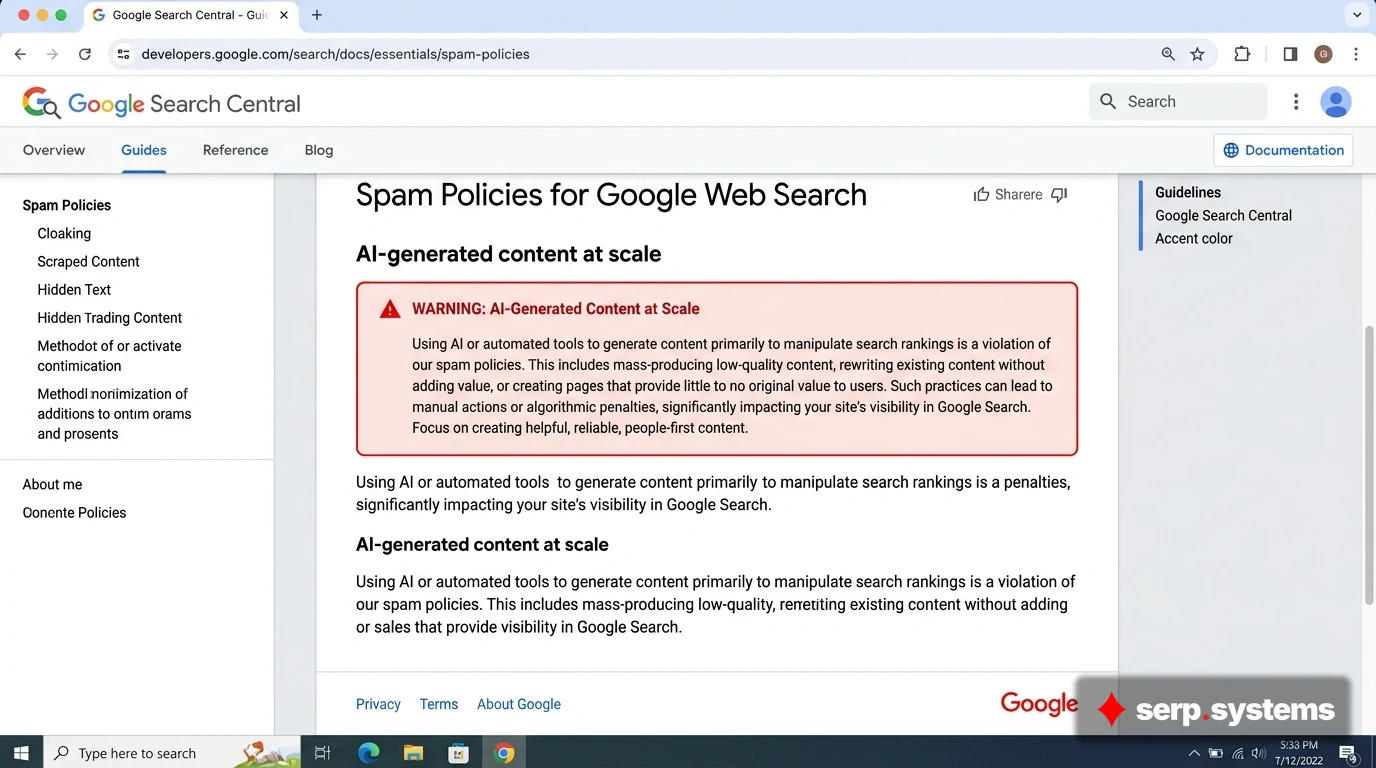
The risk here is serious: ranking drops, deindexing, or complete removal from search results. Sites caught publishing large volumes of AI content without proper review have seen entire sections or domains removed. This penalty can take months to recover from, even after you clean up the content.
Quality and Accuracy Issues
AI language models generate plausible-sounding text, but accuracy is far from guaranteed. AI systems frequently hallucinate facts, misquote sources, and present outdated information as current. These errors aren't always obvious at first glance, which makes them particularly dangerous for SEO.
When your content contains factual errors, several things happen. Readers lose trust immediately. Search engines detect bounce-backs and low engagement signals. Competitors who publish accurate information will outrank you. If your inaccuracies contradict established sources or expert consensus, Google's ranking algorithms will deprioritize your content.
For technical topics, financial advice, health information, or any area requiring precision, AI-generated content without expert review becomes a liability. A single factual error in a high-stakes topic can trigger manual action from Google's review team.
Loss of Authentic Voice and Brand Identity
Readers can sense when content lacks authentic human perspective. AI-generated text tends to follow predictable patterns—it's often generic, overly formal, or filled with hedging language that sounds robotic. This undermines your brand's unique voice and makes your content indistinguishable from thousands of other AI-generated pages.
Your brand voice is a competitive advantage. It builds trust, encourages repeat visits, and creates emotional connection with your audience. When you replace that with machine-generated text, you're essentially commoditizing your content. Users won't remember your site. They won't return. Search engines will see low repeat traffic and engagement metrics that signal lower quality.
Audiences increasingly expect transparency about AI use too. If they discover you've published AI content without disclosure, it damages credibility and can trigger negative social media responses.
Duplicate Content Problems
Here's a critical risk many overlook: multiple sites using the same AI models often generate nearly identical content. If you're using a popular AI tool without significant customization, dozens or hundreds of other sites may be generating similar text on the same topic.
Google's duplicate content algorithm penalizes this. When multiple pages have substantially similar content, Google decides which version to rank and may suppress the others entirely. If your AI-generated content matches a competitor's AI-generated content too closely, you're competing against yourself for rankings.
Even slight variations in AI output can still register as duplicate content in Google's eyes. The safer approach is human-written content with AI as a supplementary tool—not the primary content source.
E-E-A-T Signals and Credibility Concerns
Google's E-E-A-T framework (Experience, Expertise, Authoritativeness, Trustworthiness) has become central to ranking decisions. Pure AI-generated content struggles to demonstrate genuine expertise because there's no human expert behind it.
When readers can't identify who wrote the content or what qualifications that person has, E-E-A-T signals drop. This is especially damaging for YMYL (Your Money or Your Life) content—topics affecting health, finance, legal matters, or safety. Google treats these categories with extra scrutiny.
AI content also lacks the perspective that comes from real-world experience. It can't cite personal case studies, share lessons learned, or demonstrate the kind of deep domain knowledge that builds authority. Search engines have learned to detect this absence.
User Experience and Engagement Decline
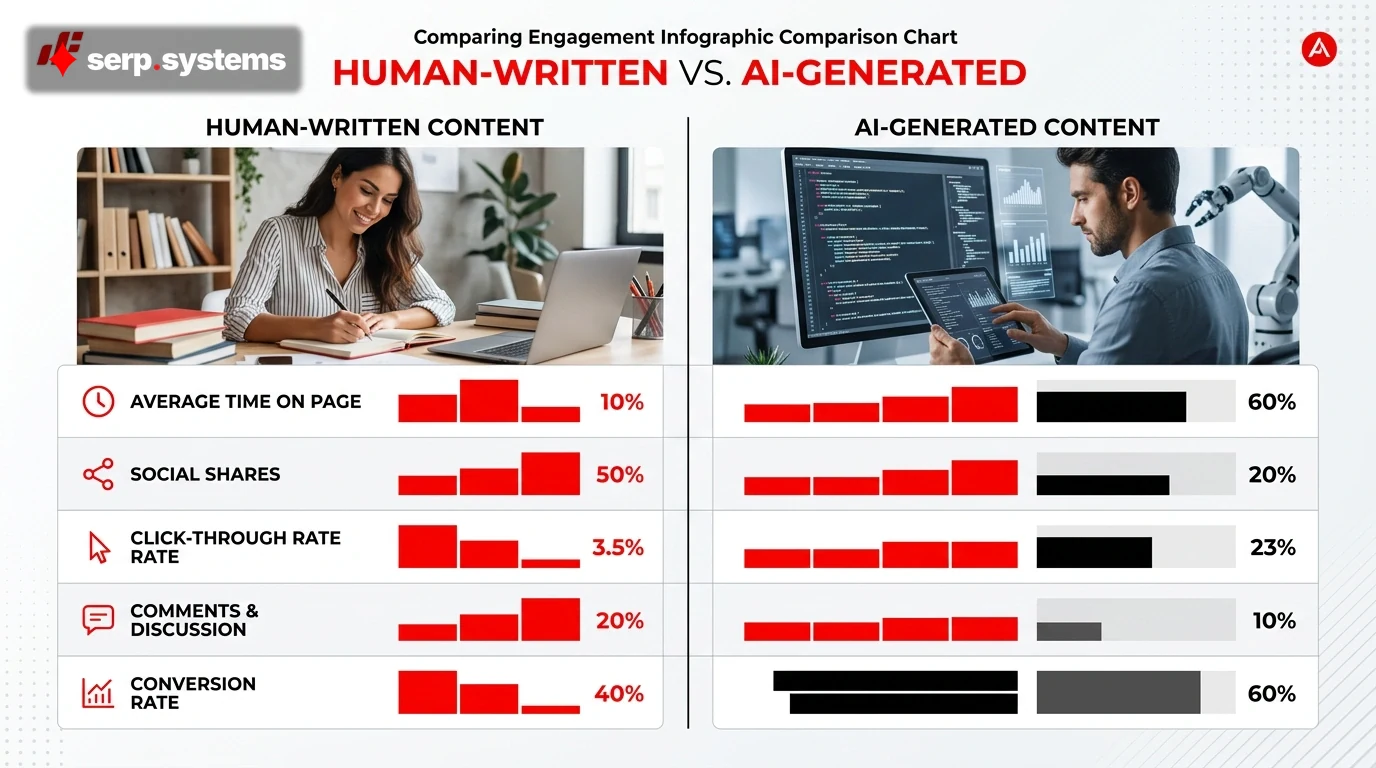
AI-generated content often fails to engage readers in meaningful ways. It answers questions mechanically without providing surprising insights, actionable takeaways, or memorable examples. This leads to higher bounce rates, shorter time-on-page, and lower conversion rates.
Search engines monitor these engagement signals closely. If your pages get traffic but users leave immediately, that's a negative ranking signal. Over time, as your engagement metrics decline, your visibility drops further.

AI content frequently misses the search intent behind queries. It might technically answer the question but miss what users actually needed. A human writer would understand context and anticipate follow-up questions. AI often doesn't.
Legal and Ethical Complications
The legal landscape around AI-generated content is still evolving, but real risks exist. Copyright and intellectual property issues arise when AI models train on copyrighted material and produce output that closely mirrors the source. Several lawsuits filed in 2025-2026 target AI companies for training on copyrighted text without permission.
If your published AI content contains material that infringes on someone's copyright, you could face takedown notices, legal action, or forced content removal. Additionally, if you're operating in regulated industries (finance, healthcare, law), publishing AI content without proper disclaimers or expert review can create compliance violations.
There's also the ethical question of transparency. Audiences deserve to know when content is AI-generated, especially if it affects their decisions. Failing to disclose AI use can damage your reputation when discovered.
How to Use AI Content Responsibly
The key is using AI as a tool within a human-centered content strategy, not as a replacement for human judgment. AI works best as an accelerant for human creativity.
Start with human expertise. Your content should begin with a real person—someone with genuine knowledge or experience in the topic. That person should define the angle, structure, and key points. Then AI can help with drafting, outlining, research synthesis, or editing.
Always review and edit AI-generated text thoroughly. Fact-check every claim. Remove robotic phrasing. Add specific examples, data, and original insights. Include author bylines with credentials. This transforms AI-assisted content into something that passes E-E-A-T scrutiny.
Consider using AI for behind-the-scenes tasks rather than final output: brainstorming headlines, generating outline variations, or helping with grammar and clarity. These uses enhance human work without replacing it.
When you're managing multiple content projects, SEO analysis tools can help you evaluate whether your final output meets quality standards before publication. Tools like serp.systems analyze content quality, track rankings, and identify gaps in your strategy—helping ensure your content meets search engine standards, whether AI-assisted or fully human-written.
Frequently Asked Questions
Will Google penalize me for using AI-generated content?
Yes, if the content is low-quality, lacks human review, or exists primarily to manipulate rankings. Google's guidelines explicitly state that AI-generated content used at scale without meaningful human contribution violates their quality standards. However, AI-assisted content that's heavily edited, fact-checked, and demonstrates expertise is generally acceptable.
How can I tell if my competitor is using AI content?
Look for patterns: generic phrasing, hedging language ("may," "could," "might"), factual inconsistencies, or content that reads smoothly but lacks personality. SEO analysis tools can help identify low-engagement content or quality issues that suggest AI generation without human review.
Is it okay to publish AI content if I disclose it?
Disclosure is important for transparency, but it doesn't solve the underlying quality problem. Even disclosed AI content needs to be heavily edited, fact-checked, and augmented with human expertise to meet E-E-A-T standards and avoid ranking penalties.
What's the difference between AI-assisted and AI-generated content?
AI-assisted content starts with human expertise and uses AI as a tool to improve efficiency. AI-generated content relies on AI as the primary creator, with minimal human input. Search engines reward the former and penalize the latter when quality is low.
Can I use AI to rewrite existing content?
Yes, if you're improving clarity, updating information, or adapting tone. However, the rewritten content should still reflect human expertise and original perspective. Simply running old content through an AI tool to create "new" versions won't help your SEO—it may actually trigger duplicate content issues.
How much human editing is enough for AI content?
There's no fixed percentage, but the standard is: enough that the final piece reflects genuine expertise, contains no factual errors, demonstrates original perspective, and reads naturally. If you're spending less time editing than you would writing from scratch, you're probably not doing enough.