Updated May 04, 2026 · 10 min read
How AI Article Generators Affect SEO Rankings in 2026
Google won't penalize AI-generated content if it's edited and valuable — but unedited, mass-produced articles tank rankings. Here's how E-E-A-T, originality, and user engagement determine whether AI content ranks in 2026.

AI article generators have become common tools for content creation, but their impact on SEO rankings remains complex. Search engines now evaluate content quality beyond surface-level metrics, and AI-generated articles occupy a contested space in this landscape. Understanding how these tools influence your rankings requires looking at both the technical and qualitative factors that Google and other search engines prioritize.
Table of Contents
- How Search Engines Evaluate AI-Generated Content
- Quality and Originality Issues with AI Content
- The Role of E-E-A-T in AI Article Ranking
- Keyword Optimization and AI-Generated Articles
- Indexing and Crawlability Concerns
- User Engagement Metrics and AI Content
- Best Practices for Using AI Generators Responsibly
- Frequently Asked Questions
How Search Engines Evaluate AI-Generated Content
Search engines like Google have made explicit statements about AI-generated content in their ranking systems. The key distinction Google makes isn't about whether content was created by AI, but whether it provides genuine value to users. AI article generators don't automatically harm your rankings if the output is edited, fact-checked, and genuinely useful.
Google's core ranking algorithm focuses on demonstrating expertise, experience, authoritativeness, and trustworthiness. These criteria apply equally to human-written and AI-assisted content. However, unedited, mass-produced AI articles tend to perform poorly because they lack the depth, specificity, and human judgment that search engines reward.
The practical reality is that search engines cannot reliably detect whether content was written by humans or AI tools. What they can detect is whether content answers user questions thoroughly, contains accurate information, and demonstrates subject-matter knowledge. An AI-generated article that's been carefully reviewed and enhanced will rank better than a poorly written human article on the same topic.
Quality and Originality Issues with AI Content
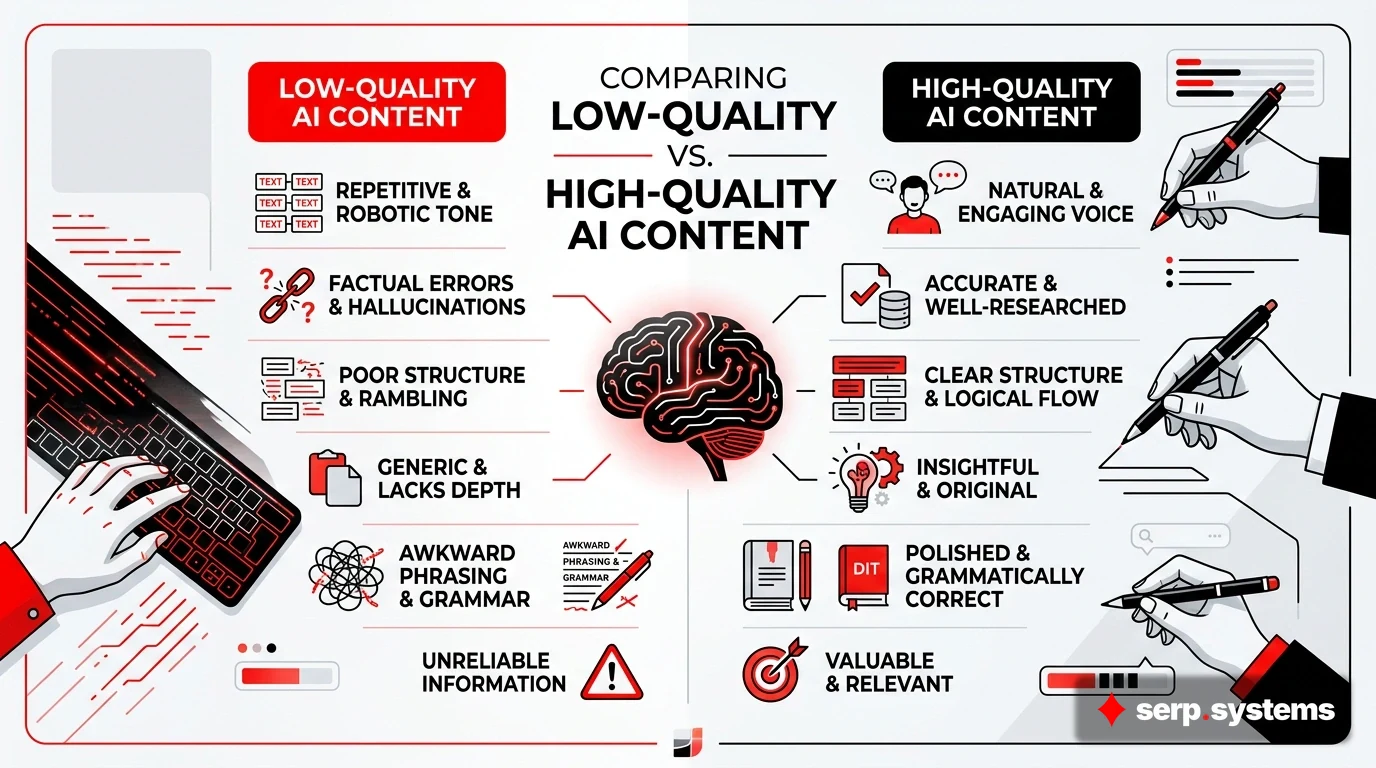
Many AI article generators produce content that's technically correct but lacks originality and depth. The problem stems from how these tools work: they're trained on existing web content and often reproduce common phrases, structures, and arguments without adding new perspectives or insights.
Originality remains a critical ranking factor. If multiple websites publish nearly identical AI-generated articles on the same topic, search engines will likely favor one version while deprioritizing the others. This creates a crowding effect where undifferentiated AI content struggles to stand out.
Additionally, AI generators sometimes produce content with subtle inaccuracies or outdated information. These errors compound when the article isn't reviewed by someone with subject-matter expertise. Search engines increasingly penalize content with factual inconsistencies, especially in YMYL (Your Money, Your Life) categories like health, finance, and legal advice.
The differentiation opportunity lies in using AI as a starting point rather than a finished product. An editor who adds original research, case studies, expert quotes, or unique analysis transforms generic AI output into content worth ranking.
The Role of E-E-A-T in AI Article Ranking
E-E-A-T stands for Experience, Expertise, Authoritativeness, and Trustworthiness. Google explicitly incorporated this framework into its ranking algorithm, and it directly impacts how AI-generated content performs.
Experience requires demonstrating real-world knowledge of a topic. An AI generator can't do this alone—it needs human input. If you're writing about SEO tools, mentioning that you've personally tested them adds credibility that no AI can fabricate. Similarly, Expertise demands subject-matter knowledge that goes beyond training data.
Authoritativeness comes from being recognized as a reliable source in your field. This builds through consistent, accurate publishing over time. An AI article published under your byline inherits your authority only if you've personally verified its accuracy and added your perspective.
Trustworthiness is perhaps most vulnerable to AI-generated content. Readers trust sources that show they care about accuracy and transparency. If your content reads like it was churned out by an algorithm without human review, trust erodes. Conversely, if you transparently acknowledge using AI tools while clearly showing your editorial oversight, you maintain credibility.
Keyword Optimization and AI-Generated Articles
AI article generators excel at incorporating keywords naturally into text. They understand semantic relationships and can weave target keywords and related terms throughout an article without creating awkward, forced language. This is one genuine advantage over poorly written human content that stuffs keywords unnaturally.
However, keyword density alone doesn't determine rankings anymore. Search engines evaluate whether content comprehensively addresses a topic, covers related concepts, and answers the questions users actually ask. An AI generator that focuses purely on keyword insertion while ignoring user intent will underperform.
The best approach combines AI's efficiency with strategic keyword planning. Use AI to draft content that naturally incorporates your target keywords, then enhance it with:
- Specific data and statistics from authoritative sources
- Real examples and case studies
- Expert perspectives and quotes
- Answers to related questions users search for
- Internal links to other relevant content on your site
This hybrid approach leverages AI's speed while maintaining the quality that search engines reward.
Indexing and Crawlability Concerns
Pure indexing and crawlability aren't typically problems with AI-generated content. Search engines can read and index AI articles just as easily as human-written ones. The technical aspects of getting your content into Google's index work the same way regardless of authorship.
Where issues emerge is with duplicate content. If you're using an AI generator to quickly produce multiple articles on similar topics, you risk creating content that's too similar across pages. Google's algorithm identifies and devalues duplicate or near-duplicate content, which can actually harm your site's overall performance.
Thin content—pages with minimal useful information—gets deprioritized. Many AI generators produce articles that are technically adequate but lack substance. A 500-word AI article that repeats the same points three times will rank worse than a 1,500-word article with diverse information and genuine insights.
User Engagement Metrics and AI Content
Search engines use engagement signals as ranking factors. These include click-through rates, time on page, and bounce rates. AI-generated content that doesn't engage readers will show poor engagement metrics, which eventually affects rankings.
AI articles often fail the engagement test because they lack personality, unique angles, or compelling narratives. They read like they were written by a machine—because they were. Readers notice this and leave quickly, signaling to search engines that the content didn't meet their needs.
The solution is editing for readability and voice. Add conversational elements, personal anecdotes, or unique perspectives that make the content feel human-written. Break up dense paragraphs, use varied sentence structures, and include examples that illustrate your points. These editing touches improve engagement metrics and, consequently, rankings.
Best Practices for Using AI Generators Responsibly
If you're using AI article generators, following these practices will protect and improve your SEO performance.
First, always edit and fact-check. Never publish AI output without reviewing it for accuracy, relevance, and quality. Verify statistics, check that links work, and ensure the article actually answers the user's question. This step separates content that ranks from content that doesn't.
Second, add original value. Include information, perspectives, or analysis that the AI couldn't generate on its own. This might be your professional experience, original research, interviews with experts, or unique case studies. Original value is what search engines increasingly reward.
Third, maintain editorial standards. Treat AI-generated drafts the same way you'd treat freelancer submissions. Would you publish the article as-is? If not, it needs more work before it goes live. Your reputation depends on content quality, regardless of how it was created.
Fourth, avoid mass production. Publishing dozens of thin, similar AI articles won't improve your rankings. It's more likely to trigger Google's spam detection. Focus on creating fewer, higher-quality articles that genuinely serve your audience.
Fifth, use AI strategically. The tool works best for specific tasks: outlining articles, generating first drafts, creating multiple versions of the same concept, or brainstorming angles. Use it where it adds efficiency without compromising quality.
Tools available through serp.systems can help you analyze content performance and understand what search engines actually reward. By combining AI generation with data-driven insights, you can create content that both ranks well and serves your audience effectively.
Frequently Asked Questions
Will Google penalize me for using AI article generators?
Google won't penalize you simply for using AI tools. The company has stated that AI-generated content is acceptable if it's high-quality, original, and helpful. The penalty comes from publishing low-quality, unedited, or duplicate AI content. If you edit and enhance AI output meaningfully, your rankings won't suffer.
How can I tell if an article was written by AI?
While AI detection tools exist, they're unreliable. Search engines can't definitively determine authorship either. What matters is the content quality and whether it provides genuine value. Focus on making your content excellent rather than worrying about detection.
Should I disclose that I used AI to write my article?
Transparency is good practice, especially if you're targeting audiences that value it. However, Google doesn't require disclosure. If you've genuinely edited and improved the content, you can publish it without mentioning AI tools. The key is that the final product meets quality standards.
Can AI-generated content rank as well as human-written content?
Yes, absolutely. If an AI article is edited, fact-checked, and enhanced with original insights, it can rank as well as or better than human-written content. The quality of the final product matters far more than the tool used to create it.
What's the best way to use AI for SEO content?
Use AI for efficiency in drafting and outlining, but invest time in editing and enhancement. Add original research, expert quotes, specific examples, and your unique perspective. This hybrid approach combines AI's speed with the quality that search engines reward.
Does AI-generated content hurt user experience?
Poorly written AI content absolutely hurts user experience. Readers notice when content reads like it was machine-generated. But well-edited AI content that's been enhanced with original value provides the same user experience as human-written content. The difference is in the editing, not the initial creation method.