Updated April 14, 2026 · 10 min read
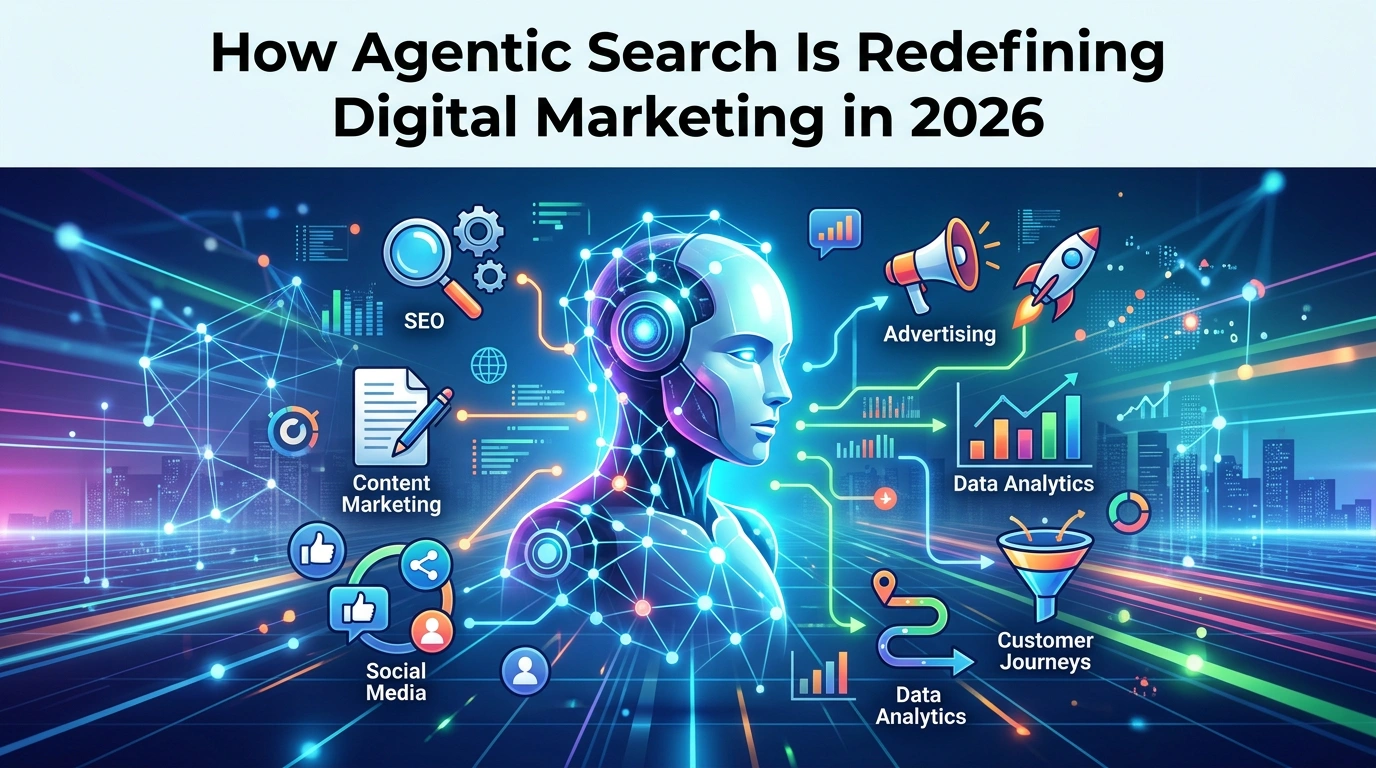
How Agentic Search Is Redefining Digital Marketing in 2026
Google is shifting search from link retrieval to task completion through AI agents. By 2026, AI Mode becomes default for logged-in users—if you're not visible there, you're invisible. Here's how to optimize.

Google's Sundar Pichai recently said the future of search is agentic, and a recent tweet from Google's search product lead shows what task-based search looks like. Search has moved from link retrieval to task completion. The internet is shifting from a model where millions of people ask the same question and get the same results to one where every person has their own AI agent running tasks on their behalf. This change is happening now, not in some distant future.
What Does Agentic Search Actually Mean?
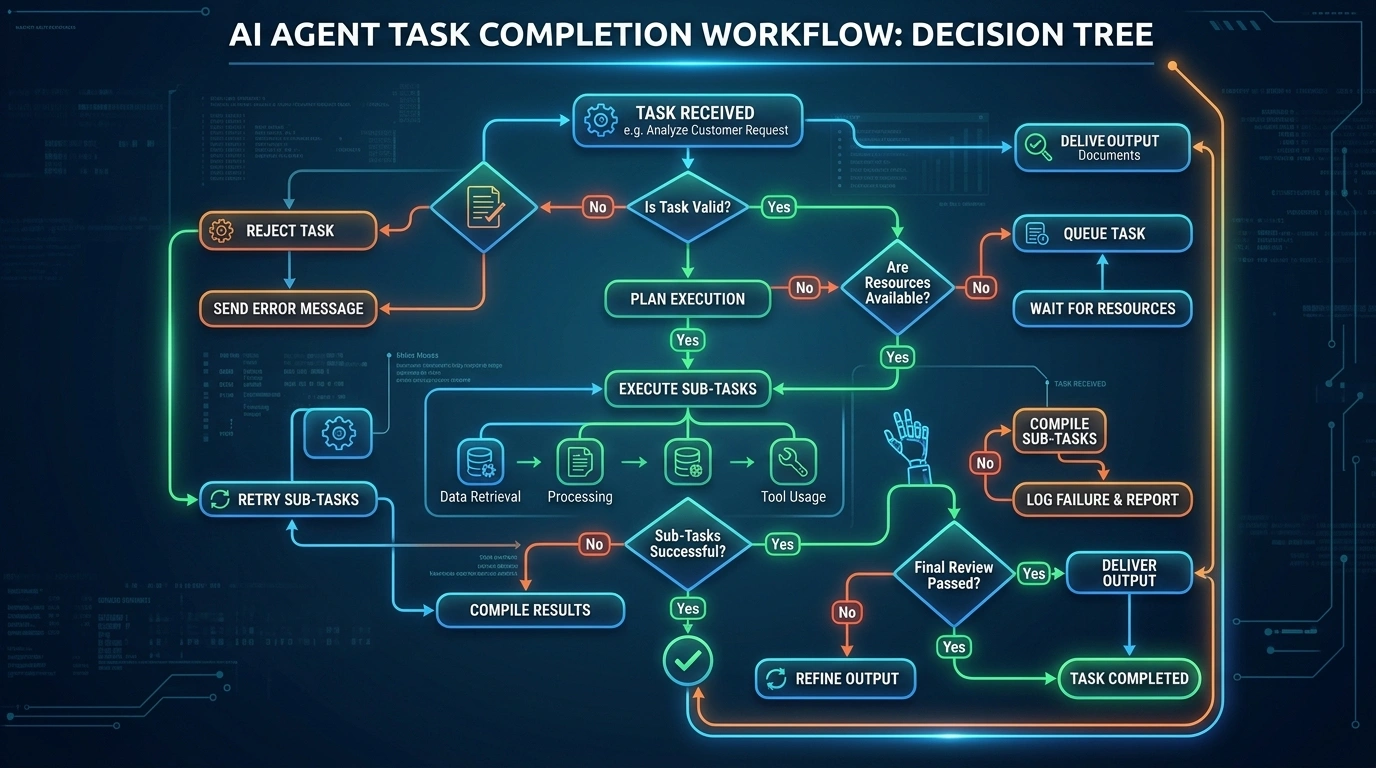
The internet with search as its gateway has been a model where websites are indexed and ranked, but AI is breaking that model because users are transitioning to researching topics where a link to a website does not provide the clear answers users are becoming conditioned to ask for. Traditional search returns a list of links. Agentic search completes tasks.
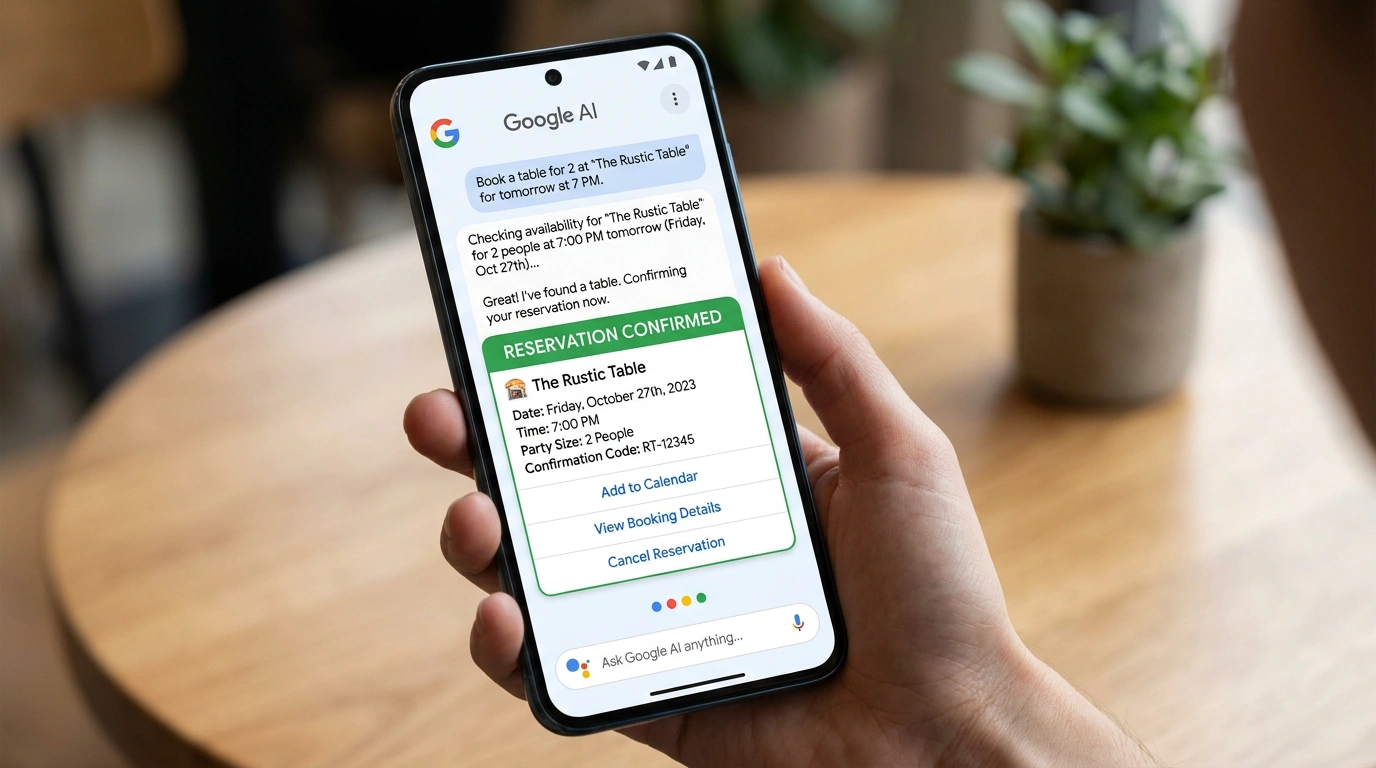
Consider a practical example. Google has expanded agentic restaurant booking in Search globally, including the UK and India, where users can tell AI Mode their group size, time, and vibe—and it scans multiple platforms simultaneously to find real-time, bookable spots. That's not search. That's task completion. You don't get a link to OpenTable. You get a reservation.
This is task completion, not search, and restaurants will need to be able to interact with these agents to provide information like available reservation slots and menu choices. The infrastructure is already in place. The shift is real and it's happening today.
How Search Is Becoming an Agent Manager
According to Pichai, a lot of what are just information-seeking queries will be agentic in search, where you'll be completing tasks with many threads running, and search would be an agent manager in which you're doing a lot of things. Google is fundamentally restructuring how search operates.
In 2026, Google Search is expected to become agentic by default—not "here are 10 links" but more like "I booked the restaurant, here's the confirmation," with operator-style functionality baked into Search and Gemini app. The window for adaptation is narrow. AI Mode is expected to stop being optional and become the default interface for logged-in users, with traditional "10 blue links" relegated to a fallback, and if you're not visible in AI Mode, you're not visible.
The Shift From Ranking to Selection
What matters now isn't traditional SEO ranking. This captures the real shift from ranking to selection in an agentic search world, where if AI agents make decisions instead of listing links, brand salience and trust become more important than traditional SEO positions. Your content doesn't need to rank #1 anymore. It needs to be trusted enough that an AI agent selects it to answer a user's question or complete their task.
This changes everything about how you approach content strategy. Brands that leverage AI SEO can ensure their offerings appear relevant within personalized ecosystems, where AI systems consider user-specific factors like location, behavior history, and preferences to curate content. Personalization has become the default rather than a feature.
Every Person Gets Their Own Personal Internet
The internet is transitioning to a model where every person has their own agent running tasks on their behalf, experiencing an increasingly personal internet. This goes beyond personalized search results. Each user gets their own version of the web, filtered through their preferences, history, and behavior.
The infrastructure implications are massive. The next adaptation introduces a hyper-personalized version of the web that impacts local SEO, shopping, and information retrieval. Your restaurant won't compete on ranking. It will compete on whether the AI agent thinks it matches what that specific user wants, right now, based on everything the system knows about them.
AI agents are currently forced to use an internet infrastructure that's built to serve humans. That's the tension. The entire web was built for human interaction. Now millions of AI agents are crawling it, reading it, and making decisions based on it. The infrastructure is starting to crack under the pressure.
WordPress 7.0 and the Content Management Shift
The Abilities API represents WordPress's formal entry into the AI-powered content management era, providing developers with tools to integrate AI services natively into WordPress, creating intelligent content workflows that were previously impossible or required complex third-party integrations. WordPress is becoming the central hub where content gets created, optimized, and prepared for distribution to AI agents.
WordPress 7.0 introduces shared AI infrastructure, including the Abilities API, AI Client, and MCP Adapter, so plugins can work together without custom integration code, with AI tools able to discover what a site can do, access AI services through a consistent layer, and trigger actions across plugins without requiring custom integration code. Before WordPress 7.0, every AI plugin was an island. Now they're connected.
After 7.0, you configure AI once and every compatible plugin benefits, with site owners adding their API keys once so every AI-powered plugin on the site can use them. This centralization matters because it means content teams can finally operate at scale without managing fragmented integrations.
Optimizing Content for AI Agents, Not Just Search Engines
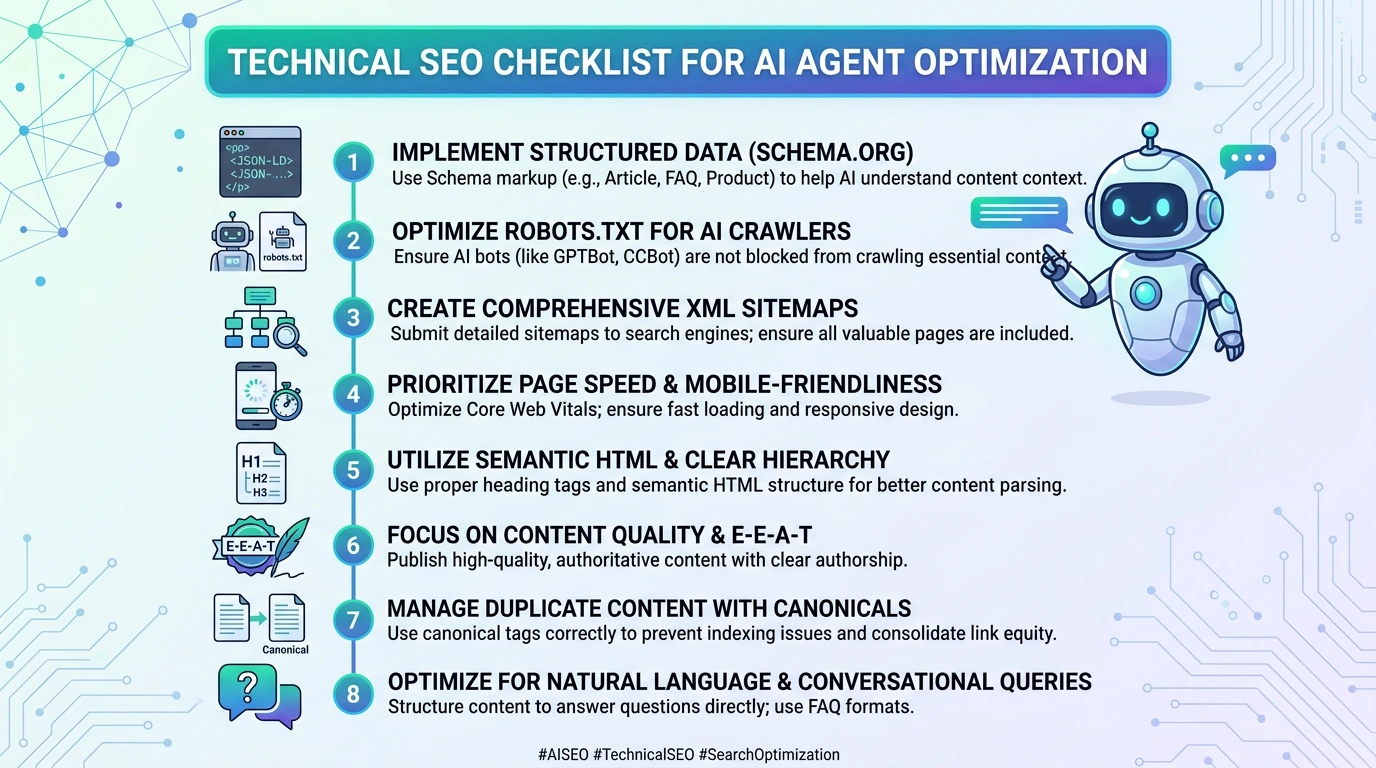
The technical SEO playbook is changing. Technical SEO extends beyond indexing to how content is discovered and used, especially as AI systems generate answers instead of listing pages, and for generative engine optimization (GEO), the underlying tools and frameworks remain largely the same, but how you implement them determines whether your content gets surfaced or overlooked.
Using schema.org markup makes your data easily interpretable by AI agents, and well-crafted FAQs and schema-marked content improve your chances of being featured as an authoritative source. Structured data is now the difference between being visible and being invisible to AI systems.
With agentic AI systems actively browsing websites on users' behalf, every technical improvement—from site speed to structured data—directly impacts visibility across growing discovery channels. One optimization benefits traditional search, AI overviews, ChatGPT, Perplexity, and emerging platforms all at once.
Content Strategy in the Agentic Age
AI agents prioritize concise, factual, and well-sourced content over attention-grabbing headlines, so to rank for AI agents, focus on creating content optimized for clarity, factual accuracy, and depth. The clickbait era is over. AI agents don't care about headlines. They care about whether your content is accurate, comprehensive, and trustworthy.
An SEO agent continuously scans search engines, AI Overviews, and generative platforms for new queries and semantic variations, then maps those signals against competitor activity and brand priorities, so marketers receive live, actionable insights they can use to publish content that drives traffic before competitors even realize the opportunity exists. Speed matters more than ever. The window to capture emerging search opportunities is shrinking.
Brands risk being excluded from AI-generated summaries if their content isn't structured in a way AI systems understand, and by the time traditional optimization happens, the window of visibility has often passed, so SEO agents automatically apply schema markup, enrich metadata, and verify semantic context to test content against AI Overview patterns to maximize its chance of inclusion.
The Real Challenge: AI Visibility Optimization
If you're not visible in AI Mode, you're not visible, and traditional SEO becomes a subset of AI visibility optimization with that window still wide open for those paying attention. But paying attention isn't enough. You need to actively optimize for it.
AI SEO agents are capable of analyzing large volumes of SERP data, including Google Search Console trends, to predict behavioral signals and give an alert when there is any algorithmic shift. The tools exist. The question is whether you're using them.
The true power of SEO AI agents lies in their ability to process vast amounts of data and make data-driven decisions, and by synthesizing these insights, the reasoning module formulates targeted optimization strategies designed to enhance search rankings and capitalize on identified opportunities. Manual optimization is becoming obsolete. Automation at scale is the new baseline.
Preparing Your Site for Agentic Search
The practical steps are straightforward but require discipline. First, audit your content structure. Make sure your site uses schema markup consistently. Second, optimize for clarity and accuracy rather than engagement metrics. Third, ensure your site is technically sound—fast, mobile-friendly, and crawlable by agents.
AI is constantly scouring the internet to maintain a fresh dataset, and if information goes stale, the platform becomes less valuable to users, which is why retrieval-augmented generation (RAG) must become a focal point. Keep your content fresh. Update dates matter. Stale content gets deprioritized by AI systems.
Fourth, consider how your content connects to other content on your site and across the web. Schema.org has been a go-to for rich snippets, but it's also evolving into a way to connect your entities online, and in 2026, you should consider making Organization and sameAs schemas, FAQPage and HowTo schemas a priority. Entity relationships matter more than ever.
Impact on Digital Marketing and Commerce
This shift affects more than just SEO. Google's vice president and general manager of ads & commerce put search and agentic commerce at the top of the company's list for changes in 2026, outlining core strategies such as how artificial intelligence will change shopping and disjointed shopping journeys, as well as advertising. Advertising itself is being reimagined. Google is not just bringing ads to AI experiences in Search but reinventing what an ad is, turning Search into a tool where ads inspire and answer questions simultaneously.
Agentic commerce is emerging where agents handle the entire shopping journey, packaging up recommended items based on context, and the ultimate future vision is total orchestration, where agents can be trusted with complex, multi-variable tasks such as planning a trip to Norway in February—identifying all the necessary gear based on travel dates, negotiating prices based on budget, and determining the best combination based on vendors, inventory ability, and shipping methods.
Why This Matters Right Now
AI agents—computers doing work on behalf of a person—are not a future concept, and ChatGPT agent activity doubled between July and August 2025, marking a watershed moment in how users interact with the web, representing 2X the number of users asking ChatGPT questions in a single month. The adoption curve is steep. The time to adapt is now.
Tools like serp.systems help teams understand how their content performs across AI search engines, not just traditional Google rankings. You can see which of your pages are being cited by AI systems, how your competitors are being positioned, and where the gaps are in your content strategy for agentic discovery.
Agentic SEO means visibility is not left to chance, with proactive agents protecting rankings, monitoring emerging AI-driven search behaviors, and pre-emptively optimizing for inclusion in generative summaries, and the business impact is resilience where executives can defend ROI on organic channels and keep their footing even when the market shifts.
FAQ
What is agentic search and how does it differ from traditional search?
Agentic search is task completion, not information retrieval. Traditional search returns links. Agentic search completes actions—booking reservations, comparing products, or answering questions—on behalf of users through AI agents that interact with websites and services automatically.
How will agentic search impact SEO strategy?
If you're not visible in AI Mode, you're not visible, and traditional SEO becomes a subset of AI visibility optimization. Content needs to be structured for AI interpretation, optimized for clarity and accuracy, and connected through proper schema markup. Ranking position matters less than being selected by AI agents.
What is WordPress 7.0's role in preparing for agentic search?
WordPress 7.0 introduces shared AI infrastructure including the Abilities API, AI Client, and MCP Adapter, so plugins can work together without custom integration code, with AI tools able to discover what a site can do and trigger actions across plugins without requiring custom integration code. This makes it easier to create content optimized for AI agents at scale.
Should I update to WordPress 7.0 immediately?
WordPress 7.0 ships with a standardized AI integration layer called the WP AI Client that allows any plugin or theme to connect to AI services through a consistent, governed interface, and the AI Connectors framework gives organizations a single layer to manage. Update when you're ready, but plan to do it before the end of 2026 to stay competitive.
How do I optimize my content for AI agents?
Focus on three things: structured data (schema markup), content clarity (factual accuracy over engagement), and technical performance (speed, mobile-friendliness, freshness). Use schema.org markup to make your data easily interpretable by AI agents, and well-crafted FAQs and schema-marked content improve your chances of being featured as an authoritative source.
What metrics should I track to measure agentic search visibility?
Monitor whether agents are hitting your site, which agents are where, and do this through log analysis and even use AI to help parse all of the data for you. Beyond that, track citations in AI-generated summaries, visibility in AI Mode results, and referral traffic from AI search engines like ChatGPT and Perplexity.